Santa Rosa, CA – Commercial property managers and business owners frequently encounter costly mistakes when approaching air conditioning installation in Santa Rosa with residential expectations. North HVAC Services, specializing in commercial applications since 1988, reports that these errors stem from fundamental misunderstandings about how commercial and residential HVAC systems differ.
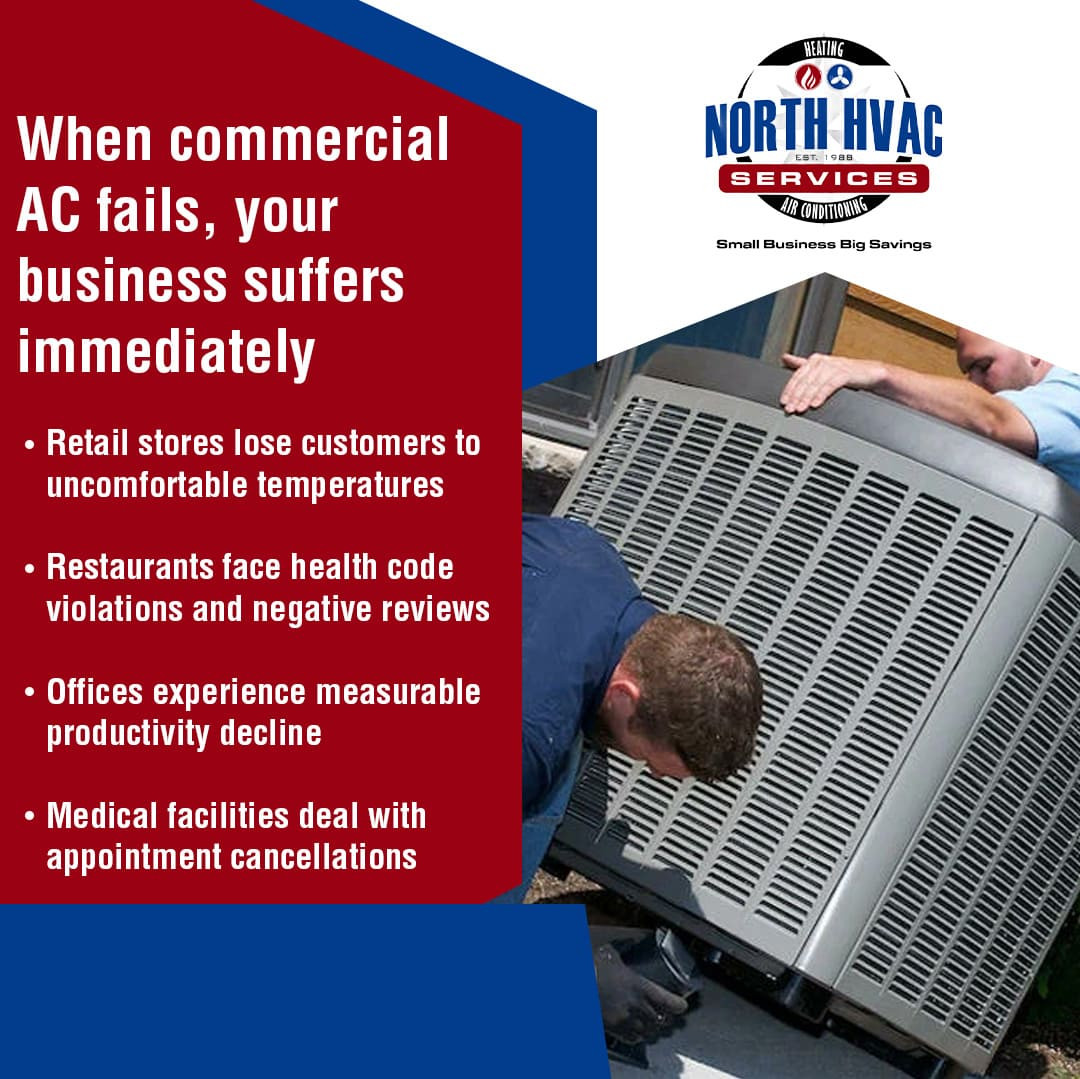
Commercial air conditioning systems operate under parameters that differ substantially from residential applications. These systems sustain longer operational cycles, accommodate higher occupancy loads, and require industrial-grade components designed for continuous duty. When commercial systems fail, consequences extend beyond discomfort to measurable revenue loss, regulatory compliance issues, and workforce productivity decline.
Critical Distinctions in Commercial Air Conditioning Installation
Residential systems run 8 to 10 hours a day on average, whereas commercial facilities run 12 to 18 hours. Restaurants, retail establishments, and office buildings require cooling during peak afternoon temperatures when residential properties remain largely unoccupied.

Occupancy density directly impacts cooling requirements:
Retail spaces may hold 50+ customers at peak, each adding about 400 BTUs.
Restaurants pack in even more people during service hours.
Offices often include server rooms that need constant cooling.
Commercial lighting produces 3–5 times more heat than residential lighting.
These combined heat sources fundamentally alter system sizing requirements for proper air conditioner installation. Commercial load calculations must account for extended operating hours, elevated occupancy density, commercial lighting output, and process equipment heat generation that residential methodology ignores entirely.
System Failure Creates Immediate Financial Impact Across Business Categories
Business operations suffer measurably when commercial AC systems fail. The revenue impact varies by industry:
Business Type | Revenue Impact | Operational Consequences |
Retail Establishment | Substantial | Customer exodus, reduced transaction time, negative review generation |
Food Service | Severe | Health code violations, critical reviews, kitchen safety concerns |
Office Environment | Moderate | Productivity degradation, increased error rates, employee dissatisfaction |
Medical Facility | Significant | Appointment cancellations, patient complaints, regulatory scrutiny |
California Title 24 Establishes Non-Negotiable Commercial Standards
California Title 24 energy efficiency standards impose stringent requirements on all commercial construction and renovation. The California Energy Commission enforces compliance through mandatory permitting and inspection protocols.
New installations must satisfy minimum efficiency thresholds. Systems exceeding 5-ton capacity require economizer controls introducing outdoor air when ambient conditions permit free cooling. The building department mandates permits for virtually all air conditioner installations in Santa Rosa, CA, with permit processing typically requiring 2 to 3 weeks.
Residential Contractors Create Risk in Commercial Applications
Property managers and business owners frequently hire residential contractors for commercial work, attracted by lower pricing and strong residential reviews without verifying commercial credentials. North HVAC Services identifies three critical failure points, as follows:
Improper Load Calculations
Residential contractors use Manual J instead of the required Manual N commercial method.
This overlooks commercial heat loads like display lighting and high occupancy.
The result is undersized equipment that cannot meet actual building demands.
Code Compliance Failures
Lack of familiarity with California Title 24 commercial requirements.
Missing economizers or poor duct insulation cause inspection failures.
Delays occupancy permits and requires expensive remediation.
Premature Equipment Failure
Improperly sized systems wear out quickly under commercial duty cycles.
Residential-grade equipment breaks down under continuous run time.
Compressors can fail in 3–5 years instead of the expected 15–20.
System Selection Determines Performance and Operational Efficiency
Three primary system configurations dominate commercial installations. Rooftop package units represent the commercial standard, integrating all system components within a single weatherproof enclosure. Commercial buildings predominantly utilize rooftop units because they consume no rentable interior space, and installation occurs with minimal disruption to ongoing operations.
Split systems provide ground-level alternatives when rooftop installation proves impractical. Ground-mounted systems suit historic structures or buildings lacking adequate structural capacity for rooftop loads.
Ductless mini-split systems deliver zone-level control by connecting a single outdoor condensing unit to multiple indoor air handlers. The U.S. Department of Energy reports that duct losses can account for more than 30% of energy consumption for space conditioning, making ductless systems more efficient by eliminating this energy waste entirely.
System Type | Installation Duration | Optimal Applications | Design Life |
Rooftop Package Unit | 3 to 4 days | Retail, food service, office buildings with flat roofs | 15 to 20 years |
Commercial Split System | 3 to 5 days | Historic buildings, ground-floor applications | 15 to 18 years |
Multi-Zone Ductless | 4 to 7 days | Mixed-use properties, tenant spaces, data centers | 15 to 20 years |
Contractor Selection Requires Commercial Credentials Verification
Professional air conditioner installation services begin with California contractor license verification. The state mandates C-20 Warm Air Heating, Ventilation, and Air-Conditioning licenses for HVAC installations. Verification of license status, bond coverage, and insurance through CSLB.ca.gov represents an essential first step.
Manufacturer certifications demonstrate factory training on specific equipment lines. EPA Section 608 certification is federally mandated for refrigerant handling, ensuring environmentally compliant practices and proper system charging procedures.

Preventive Maintenance Protects Long-Term Investment Value
Well-maintained commercial systems achieve a 15 to 20-year service life compared to neglected systems typically fail between 8 to 12 years. According to the Pacific Northwest National Laboratory's Operations and Maintenance Best Practices Guide, operations and maintenance programs targeting energy and water efficiency are estimated to save 5% to 20% on energy bills without significant capital investment.
Maintenance contracts include bi-annual inspections as the minimum service frequency. Spring service prepares cooling systems for summer demand while fall service readies heating equipment for winter operation.
About North HVAC Services
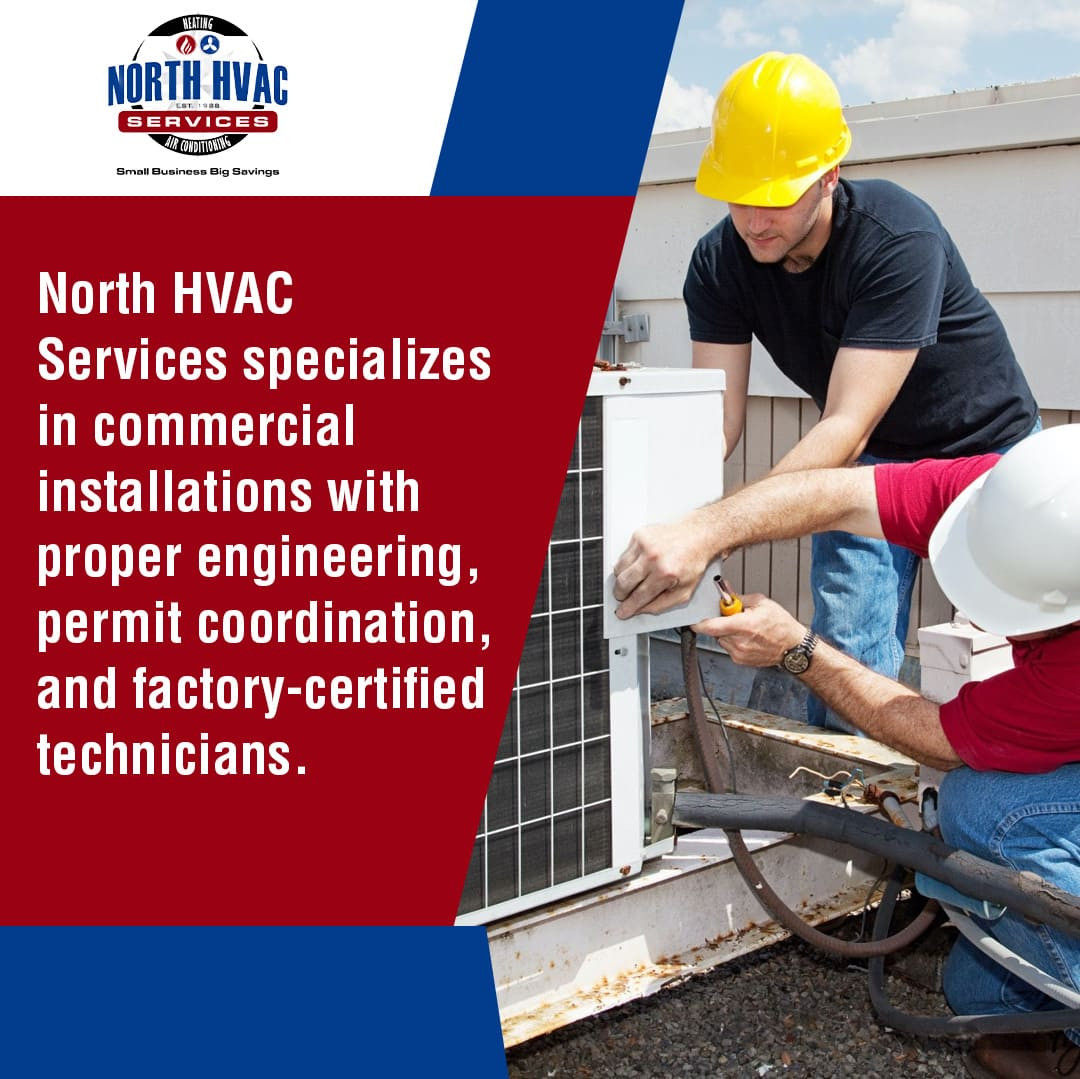
North HVAC Services has specialized in commercial AC installation in Santa Rosa, CA, and throughout Sonoma County since 1988. As a Mitsubishi Diamond Authorized Dealer and factory-authorized dealer for Trane and Day & Night, the company provides expert system design, load calculations, permitting, and installation for retail, food service, office, and medical facilities.
For proposals or service, contact North HVAC Services at (415) 845-6910 or [email protected].