
SHENZHEN, GUANGDONG, CHINA, August 21, 2026 /EINPresswire.com/ — Highway gantry networks, long-distance roadside billboards, and rooftop advertising structures present punishing operational environments in commercial display engineering. When outdoor screens face direct sunlight, heavy storms, industrial saline mist, and continuous vibration from traffic, standard surface-mount device displays often suffer from thermal degradation and low contrast. For system integrators and procurement managers overseeing large-scale roadside infrastructure, high-brightness visibility and mechanical reliability require a durable optical architecture. In these long-view deployments, Smart DIP Modules combine through-hole LED encapsulation with a cabinet-free structural design. The architecture prioritizes optical output, heat dissipation, and service access without adding close-view pixel density that the application does not require. As municipal authorities and commercial media operators demand higher operational availability and predictable total cost of ownership, dual-in-line package modules remain a practical option for long-distance outdoor digital display networks.
DIP vs. SMD in Long-View DOOH: Optical Performance, Contrast, and Environmental Resilience
Evaluating display technology for viewing distances exceeding twenty meters reveals distinct optical tradeoffs between surface-mount devices and dual-in-line package encapsulation. While standard SMD architecture packs multiple RGB chips into a single flat bead ideal for indoor pitches, outdoor DIP technology utilizes through-hole lamp encapsulation with independent, vertically seated red, green, and blue pins. This physical separation allows each diode to operate with larger internal surface areas and thicker gold wire bonding, resulting in exceptional luminous flux and thermal endurance under continuous high-power drive currents.
Shenzhen Chip Optech Co., Ltd. optimizes this advantage by integrating P10 DIP346 and P16 to P20 DIP310 gold wire lamp packaging into high-output outdoor systems. Peak brightness performance reaches from 8,500 cd/m² up to 12,400 cd/m², ensuring crisp readability even when sun angles align directly with the screen. Each module incorporates engineered anti-glare sunshades and deep louvers that block overhead ambient light while protecting individual pins from physical impact. Combined with high-thermal-conductivity epoxy resin potting encapsulation, this architecture prevents internal thermal shock and UV discoloration, delivering uncompromised contrast across severe temperature swings and maritime salt-fog exposure.
Cabinet-Free Smart Module Engineering: Eliminating Traditional Structures for Gantry Deployments
The true paradigm shift in modern long-view outdoor display engineering lies in the mechanical transition from cumbersome metal cabinets to modular, self-contained architectures. Traditional outdoor billboards rely on heavy steel or cast aluminum outer enclosures to provide structural rigidity and weatherproofing. However, when deploying large digital displays on elevated highway gantry trusses or cantilever structures, the dead weight of conventional cabinets imposes severe loads that escalate civil engineering costs and complicate structural approvals.
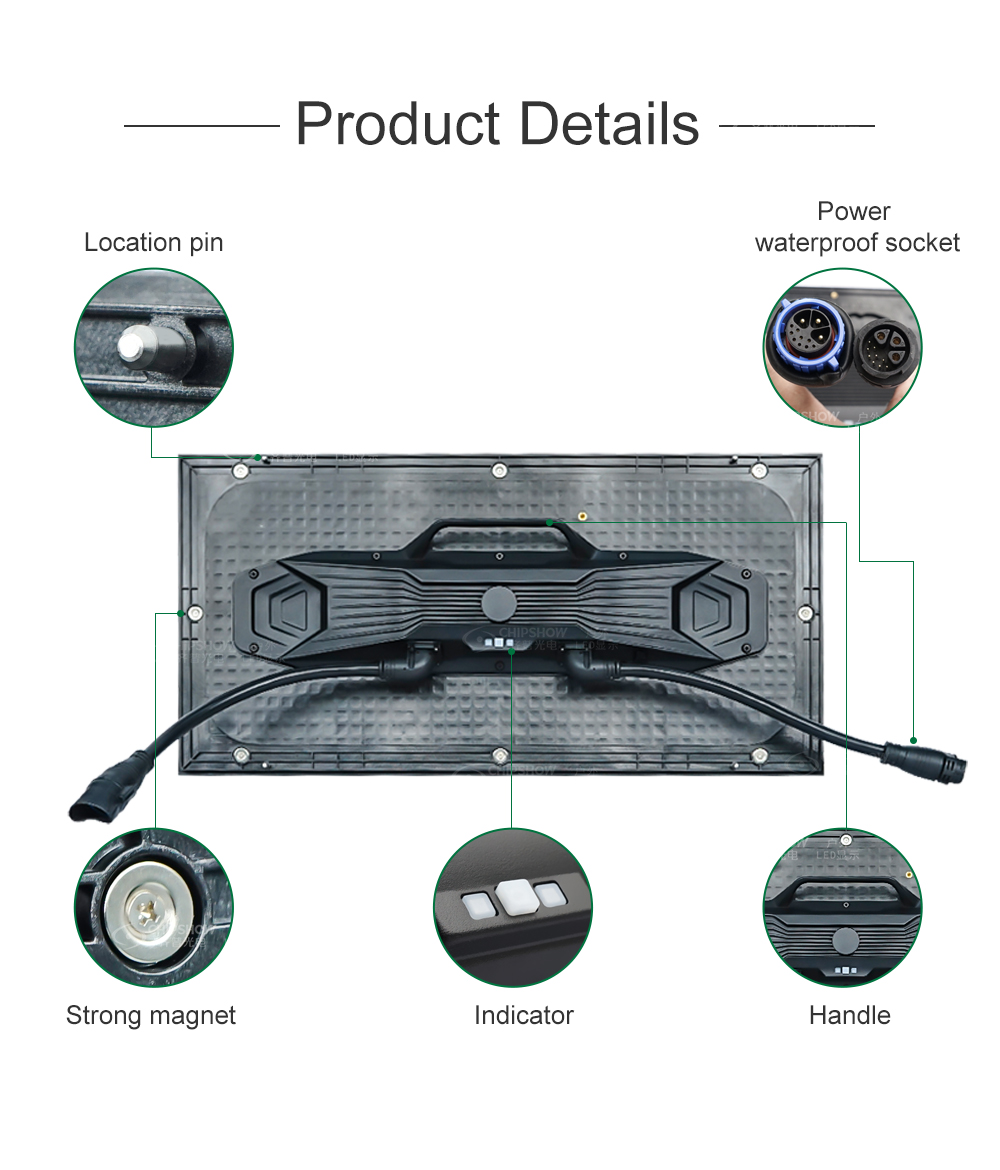
To eliminate this bottleneck, Chipshow developed the C-Smart long-view platform around standardized 640 by 320 mm independent smart modules that attach directly to lightweight mounting profiles without requiring an exterior metal cabinet. Removing the outer metal housing lowers the overall face weight of the display structure to 26 kilograms per square meter or less. This reduces structural dead load by more than fifty percent compared to legacy cabinet systems. This weight reduction simplifies civil engineering requirements and allows rapid installation onto existing highway gantries. Despite the absence of an outer enclosure, every self-contained module achieves independent IP65 and IP66 ingress protection ratings across front and rear surfaces, preventing water ingress during wind-driven storms.
Patent-Backed Engineering: Thermal Management, Weather Sealing, and Dual-Maintenance Efficiency
Sustaining consistent high-brightness performance across multi-year deployments requires rigorous intellectual property protections and advanced thermal engineering. High power densities within outdoor billboards generate localized heat that, if trapped inside enclosed frameworks, accelerates LED lumen degradation and drives premature power supply failure. Addressing these thermal and mechanical challenges requires verified engineering innovation backed by enforceable international patents.
Driven by an R&D foundation established in 2001, the company holds 58 verified technical patents, including 30 invention patents, 13 utility models, 8 industrial designs, and 6 software copyrights. A cornerstone of this portfolio is the proprietary Smart Module architecture, which secured its United States invention patent in 2022 and its European Union invention patent in 2023. This patented design pairs aviation-grade die-cast aluminum heat-dissipation rear shells with passive, fanless thermal pathways that exhaust internal heat without drawing external dust into the electronics compartment. In the field, this self-cooling architecture operates at an average daily power consumption of 140 watts per square meter while enabling dual front and rear maintenance. Single technicians can unlock and replace a complete smart module in under three minutes, compressing emergency maintenance windows on high-traffic corridors.
Application-Specific Compliance for Long-View Outdoor and Traffic Projects
For commercial property developers, highway contractors, and municipal procurement agencies, technical compliance documentation represents a critical risk-mitigation checkpoint. Unverified generic safety claims expose contractors to inspection rejections, electrical hazards, and customs clearance delays during international shipment. Professional procurement standards dictate that every display module must correspond directly to accredited third-party laboratory test files rather than relying on blanket manufacturer promises.
For P10, P16, and P20 outdoor DIP modules, Chipshow uses model-matched test files issued through international testing organizations including TUV SUD.
European outdoor project qualification centers on CE Low Voltage and Electromagnetic Compatibility documentation together with RoHS environmental reports.
Roadway variable message sign and traffic guidance projects can additionally be checked against the relevant European EN12966 optical test dossier. This application-specific structure keeps the selected module, destination market, and project standard aligned during procurement.
Procurement Evaluation & Total Cost of Ownership (TCO) for High-Brightness Outdoor Projects
Achieving superior total cost of ownership across a ten-year operational lifecycle requires evaluating the complete supply chain, from manufacturing quality control to post-installation energy efficiency. Low initial purchase prices are quickly erased if a display network suffers from high electrical operating costs, frequent component failures, or prolonged shipping lead times for spare parts.
At the core of the manufacturing strategy is a 25,000-square-meter modern production base equipped with automated high-speed SMT assembly lines and quality management systems certified under ISO 9001, ISO 14001, and ISO 45001. Every completed display module undergoes a mandatory 72-hour continuous full-screen aging test before dispatch, guaranteeing high product consistency and exceptional yield reliability for large-scale rollouts. To support international timelines, regional direct warehouses and technical service centers operate in California, USA, and the Netherlands, Europe. This localized inventory infrastructure allows contractors across North America and Europe to access immediate stock fulfillment and rapid spare part dispatch without cross-border shipping delays. Common-cathode electronic circuitry reduces operational power consumption by up to thirty percent. Combined with a cabinet-free mechanical profile that cuts structural installation costs, the platform delivers exceptional return on investment for outdoor advertising infrastructure.
The manufacturer combines the rugged visibility of traditional DIP lamp encapsulation with the efficiency of cabinet-free smart module architecture. This approach reflects a decades-long commitment to display engineering and the brand promise “Try once, Trust forever.” Whether upgrading existing highway gantries, constructing commercial rooftop billboards, or deploying municipal guidance screens, engineered smart DIP modules provide the ultimate assurance of ten-year operational reliability. For complete P10, P16, and P20 technical documentation, accredited compliance test reports, or customized outdoor display consultations, visit the official website at https://www.chipshow.com/.
Shenzhen Chip Optech Co., Ltd.
Chipshow
email us here
Visit us on social media:
LinkedIn
Instagram
Facebook
YouTube
TikTok
X
Legal Disclaimer:
EIN Presswire provides this news content “as is” without warranty of any kind. We do not accept any responsibility or liability
for the accuracy, content, images, videos, licenses, completeness, legality, or reliability of the information contained in this
article. If you have any complaints or copyright issues related to this article, kindly contact the author above.

Media gallery