

pikselstock // Shutterstock
2026 report: Costs of long-term care and senior living
Understanding the costs of long-term care is an essential part of planning for senior living and in-home care. A Place for Mom provides proprietary cost benchmarks drawn from its nationwide network of partner communities and agencies.
This report includes cost data for senior living — independent living, assisted living, and memory care — as well as home care. Senior living figures reflect actual monthly costs paid by residents who moved into a community during calendar year 2025, including base rent and care fees where applicable. Home care figures are based on hourly starting rates reported by partner agencies and captured in early 2026.
This report primarily uses median values to provide a reliable benchmark that is less influenced by unusually high or low prices. While many families search for the average cost of long-term care, medians better reflect what families typically pay.
National median costs of long-term care and senior living
- Assisted living: $5,419 per month
- Memory care: $6,690 per month
- Independent living: $3,200 per month
- Home care: $34 per hour
Costs are structured differently across care types and settings. Residential senior living options are typically priced as monthly rates that bundle housing with services such as meals, activities, and varying levels of personal care.
Independent living is generally the most affordable type of senior living, since it does not provide hands-on care. Memory care typically costs more due to increased staffing levels, specialized dementia training, and enhanced safety features.
Home care is most often billed hourly, reflecting the flexibility of services delivered in a private residence. Total monthly home care costs depend on the number of hours provided and the intensity of care required, which can make direct comparisons with residential options more complex.
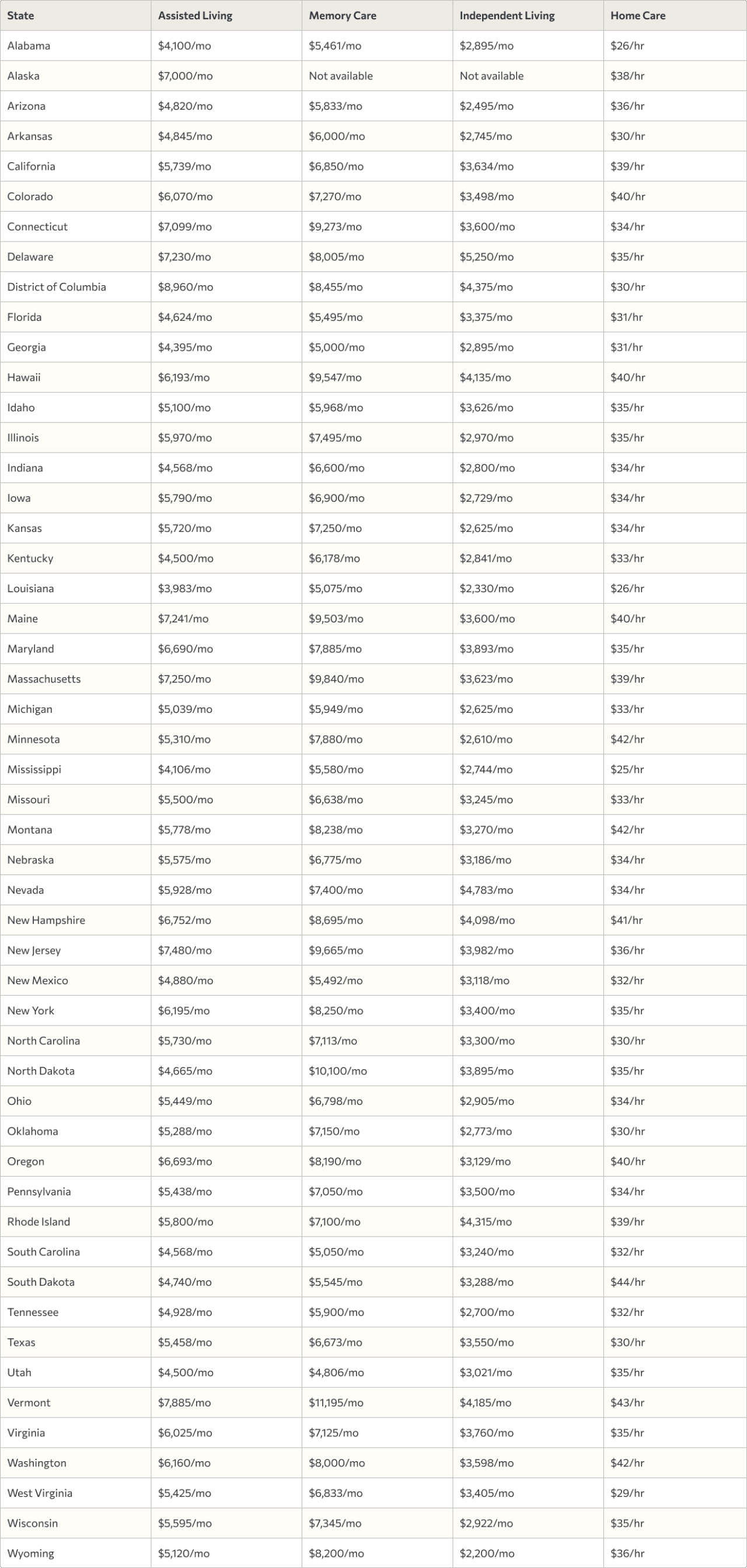
Median long-term care and senior living costs by state
Long-term care and senior living costs vary widely by state due to differences in labor costs, real estate markets, regulatory environments, and the balance between supply and demand for senior care services.
States with higher senior living costs often overlap with regions that have above-average housing prices and wages, while lower median costs are more common in parts of the Midwest and South. However, lower costs do not always correspond to greater access, particularly in markets where limited supply constrains availability.
Senior living costs by floor plan type
Apartment size and layout can significantly affect the cost of senior living, though premiums vary by care type and market. Studio apartments are typically the most affordable option, while one- and two-bedroom units command higher monthly rates.
In assisted living, the median starting price of a one-bedroom apartment is often $900 to $1,200 per month higher than a studio, with two-bedroom units carrying substantially larger premiums. Independent living generally shows smaller differences between floor plans, while memory care pricing varies more widely due to specialized staffing requirements and secure design considerations.
Larger floor plans are not available in every market, particularly in memory care settings. As a result, both availability and pricing should be considered when comparing senior living options across states.
The following tables show median monthly starting prices for the most common floor plans in senior living communities across all 50 states and the District of Columbia. Starting prices are reported by communities in A Place for Mom’s partner network and generally reflect base rent, excluding additional fees for care services, pets, or other optional charges. Floor plan pricing reflects starting rates captured in early 2026.
A Place for Mom

A Place for Mom

A Place for Mom

A Place for Mom
Senior living and long-term care costs over time
A Place for Mom’s proprietary data shows that senior living costs increased from 2024 to 2025, extending a multiyear upward trend across major care types. Median costs rose across independent living, assisted living, and memory care. Senior living median cost comparisons reflect calendar year 2024 and 2025 data.
Home care hourly rates, captured in early 2026, also reflect continued upward pricing pressure.
While year-over-year increases vary by care type and market, the overall direction of pricing remains upward.
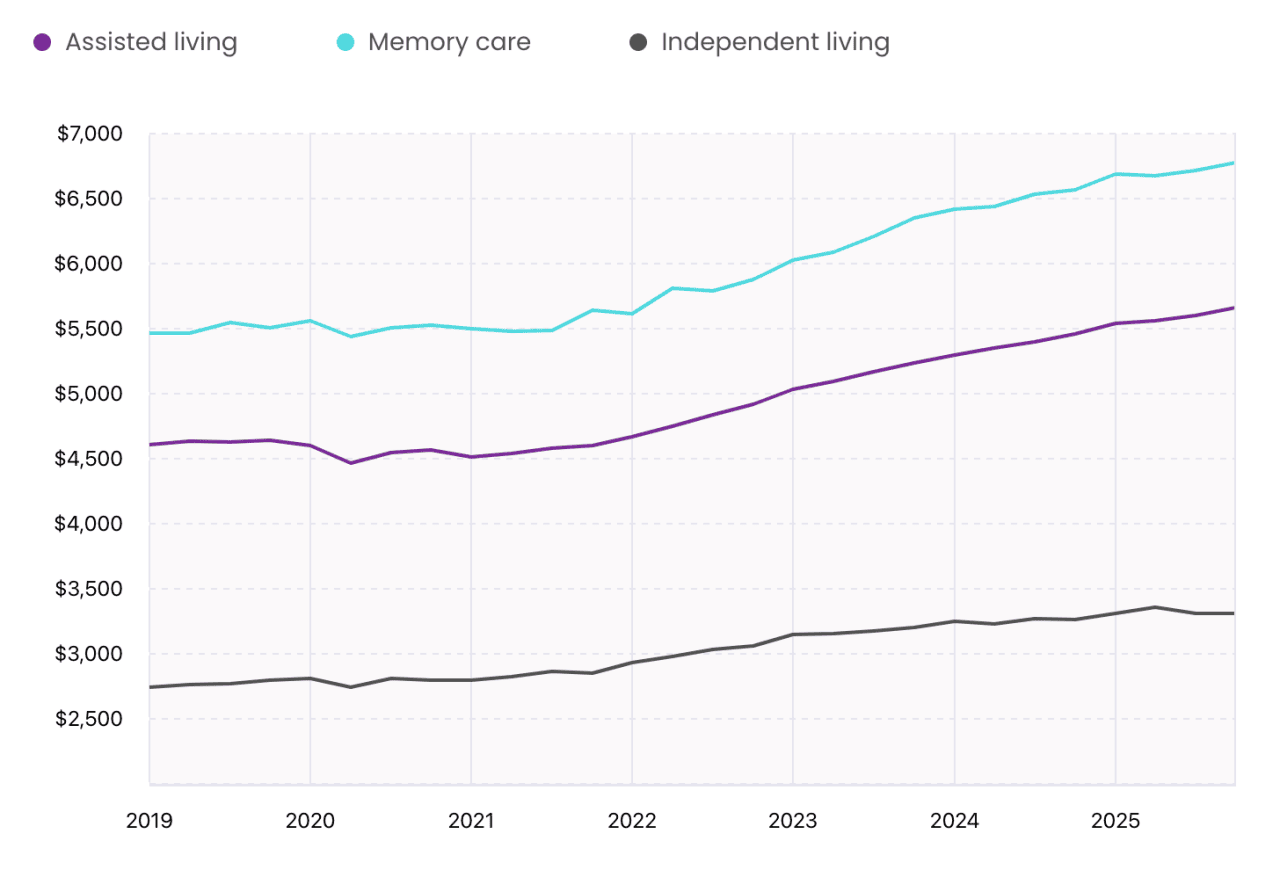
Average senior living costs, 2019-2025
The line graph below shows how the national monthly costs for assisted living, memory care, and independent living have changed since 2019. Unlike most of the data in this report, this graph reflects quarterly average costs paid after residents moved in. In this context, averages are used to better illustrate pricing trends over time, as they more clearly capture the impact of rising costs, post-pandemic occupancy demand, and limited new construction in some markets.
A Place for Mom
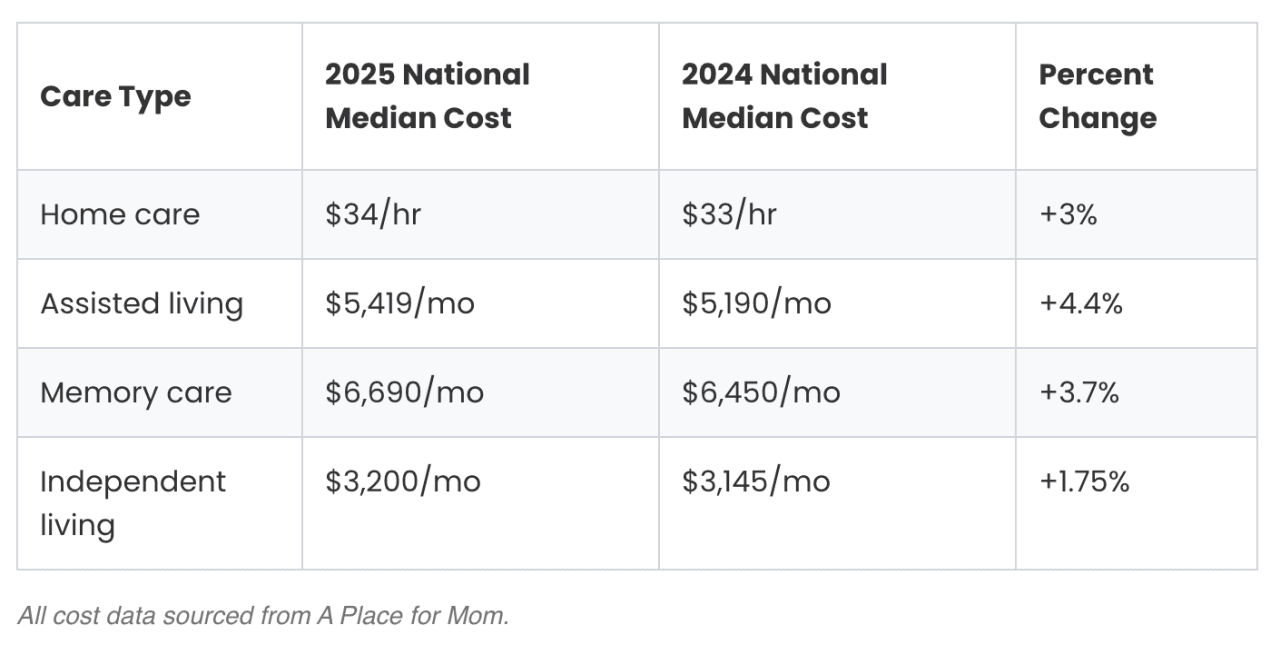
Median cost changes by care type, 2024-2025
This table shows the national median costs by care type comparing 2025 to 2024.
A Place for Mom
Calculating the costs of long-term care and senior living
A Place for Mom calculates the costs of long-term care using a consistent approach designed to support national- and state-level comparisons. Cost data is collected from partner providers, standardized across markets, and analyzed to reflect typical pricing. This methodology is intended to benchmark costs across settings, not to estimate what any individual family will pay.
Median cost data for senior living communities
Median cost data for independent living, assisted living, and memory care is based on actual costs paid by residents who moved in during calendar year 2025. For each move-in, the reported cost includes base rent and care fees when care is provided.
In states where move-in data was not available, median costs are based on averaged published rates for common room types and care fees. If neither move-in data nor published rate data was available for a given setting, cost data is not shown for that location.
Assisted living median costs are based on 24,305 family move-ins recorded during calendar year 2025, independent living cost data reflects 13,528 move-ins, and memory care cost data is based on 10,474 memory care move-ins.
Median cost data for home care
Home care cost data in this report was captured Jan. 9, 2026, and is based on hourly starting rates shared by 3,215 home care agencies in A Place for Mom’s network.
Actual home care costs vary based on the number of hours arranged and type of care provided. Because schedules and needs differ, home care costs in this report are shown as hourly rates rather than fixed monthly totals. The national median hourly rate provides a general reference point, but a family’s total monthly cost will depend on how many hours of care are arranged.
Most home care agencies require a weekly minimum of seven hours, and some offer up to 24-hour or live-in care options. The most common home care schedule is approximately 20 nonsleeping hours per week, which equates to $2,944 per month based on the national median hourly rate of $34.
Context sources
In addition to proprietary cost data from A Place for Mom’s partner network, this report references publicly available government data and industry research to provide general context on labor markets, housing costs, inflation, and senior living supply and demand. These sources are not used to calculate the cost figures presented in this report.
Sources referenced for context include the U.S. Bureau of Economic Analysis, U.S. Bureau of Labor Statistics, National Investment Center for Seniors Housing & Care, and Senior Housing News.
This story was produced by A Place for Mom and reviewed and distributed by Stacker.

