Bio-solvents and battery electrolyte demand drive steady market growth
ROCKVILLE, MD, UNITED STATES, April 16, 2026 /EINPresswire.com/ — According to the latest market analysis by Fact MR, Germany is solidifying its position as Europe’s “Green Solvent Regulatory Laboratory.” As the nation accelerates its transition toward sustainable industrial processing, glycerol carbonate—a bio-derived cyclic carbonate—has emerged as a critical component in the evolution of coatings, polymers, and next-generation energy storage.
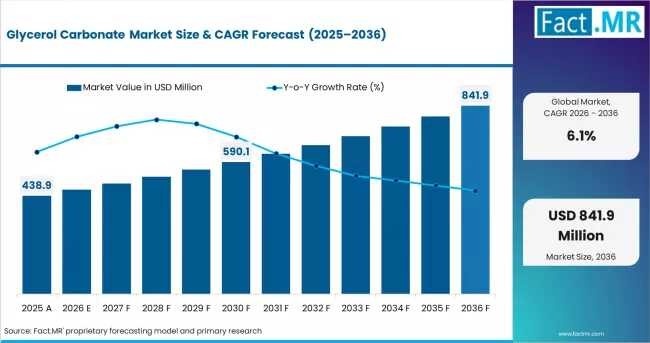
The glycerol carbonate market is valued at USD 438.9 million in 2026 and is projected to reach USD 792.3 million by 2036. Forecast to expand at a CAGR of 6.4% in Germany, the market represents an incremental opportunity of USD 353.4 million. This growth is underpinned by the valorization of glycerin from biodiesel production and the increasing demand for high-polarity, low-toxicity intermediates that comply with stringent EU REACH regulations.
Get detailed market forecasts, competitive benchmarking, and pricing trends:
https://www.factmr.com/connectus/sample?flag=S&rep_id=14732
Quick Stats Section
Market Size (2026E): USD 438.9 Million
Forecast Value (2036F): USD 792.3 Million
Projected CAGR (Germany):4%
Leading Segment by Function: Solvents (39% Share)
Leading End-Use Industry: Chemicals (37% Share)
Key Regional Players: BASF SE, Merck KGaA, Huntsman Corporation, UBE Corporation, Arkema S.A.
Executive Insight for Decision Makers
The market is witnessing a fundamental strategic shift: the transition from petrochemical-based carbonates to multifunctional, bio-derived alternatives. For OEMs and chemical manufacturers, the message is clear—formulation efficiency now depends on the adoption of solvents that offer both high electrochemical stability and environmental compliance.
“Germany’s leadership in the glycerol carbonate space is intrinsically linked to its advanced specialty chemical innovation ecosystem,” says Shambhu Nath Jha, Principal Consultant at Fact MR. “Manufacturers who prioritize purity consistency and process efficiency, particularly for the burgeoning lithium-ion battery sector, are positioned to capture the highest value growth through 2036. The risk of ignoring these bio-based intermediates is not just a regulatory hurdle; it is a loss of competitive edge in high-performance polymer and electrolyte markets.”
Market Dynamics
Key Growth Drivers:
Electrochemical Stability: Rising demand for carbonate-based electrolyte intermediates in the EU’s battery gigafactories.
Regulatory Compliance: The EU REACH framework continues to drive the substitution of volatile organic compounds (VOCs) with low-toxicity bio-solvents.
Feedstock Valorization: Value chain integration with the biodiesel industry ensures a steady supply of glycerol feedstock.
Key Restraints:
Feedstock Price Volatility: Glycerol pricing remains tied to biodiesel production cycles, impacting downstream carbonate stability.
Substitution Competition: Established petrochemical carbonates still hold a cost advantage in non-regulated industrial sectors.
Emerging Trends:
Multifunctional Intermediates: Use of glycerol carbonate as a reactive intermediate in advanced polymer crosslinking.
Personal Care Innovation: Increasing incorporation in low-toxicity, skin-friendly cosmetic formulations.
Segment Analysis
Solvent functionality leads the market with a 39% share in 2026. Its polar aprotic characteristics make it indispensable for dissolving polymers and electrolytes that require controlled viscosity. The Chemicals Industry remains the dominant end-user at 37%, utilizing the compound as a versatile building block for laboratory-scale synthesis and large-scale industrial processing.
Supply Chain Analysis: The Valorization Loop
The glycerol carbonate supply chain is a prime example of circular chemical economy:
Raw Material Suppliers: Biodiesel producers provide crude and refined glycerol.
Producers: Specialty chemical giants like BASF SE and Huntsman convert glycerol into high-purity carbonate via transesterification.
Distributors: Global logistics players (e.g., Merck KGaA, Alfa Aesar) ensure high-purity delivery to specialized labs and factories.
End-Users: Paint and coating manufacturers, battery cell producers, and cosmetic formulators.
Strategic Integration: In Germany, the supply chain is highly integrated, with companies like BASF expanding manufacturing capacity (January 2023) to supply domestic automotive and energy storage sectors directly.
Pricing Trends
The market operates on a Premium Specialty pricing model rather than a commodity one.
Influencing Factors: Final pricing is heavily dictated by purity grades (e.g., reagent grade vs. industrial grade) and the cost of glycerol refining.
Margin Insights: High-purity grades for the pharmaceutical and battery sectors command the highest margins, as these applications require rigorous certification and minimal moisture content.
Regional Analysis: Germany in the Global Context
While China (7.2% CAGR) leads in volume due to massive battery production, Germany (6.4% CAGR) represents the highest value-density market.
Developed vs. Emerging: Unlike emerging markets focused on low-cost industrial solvents, the German market is driven by “Replacement Procurement Cycles,” where legacy solvents are swapped for bio-based alternatives to meet ESG goals and technical performance requirements in high-end coatings and electrolytes.
Competitive Landscape
The market structure is moderately fragmented. Established leaders like Huntsman and UBE Corporation benefit from chemical engineering heritage, while Merck KGaA and Tokyo Chemical Industry (TCI) dominate the high-margin laboratory and reagent segments.
Strategic Moves:BASF SE and Arkema S.A. are currently leading the charge in Germany by expanding their bio-based chemical intermediate portfolios to serve the localized “Green Deal” initiatives.
Strategic Takeaways
For Manufacturers: Enhance supply chain integration with biodiesel producers to mitigate glycerol price volatility.
For Investors: Focus on producers with patented, high-efficiency synthesis pathways that reduce the carbon footprint of production.
For Marketers: Position glycerol carbonate as a multifunctional performance enhancer, not just a “green” substitute.
Future Outlook
By 2036, glycerol carbonate will be a cornerstone of solid-state battery research and sustainable polymer engineering. As technology advances, the long-term opportunity lies in the development of “Direct Synthesis” methods that could further decouple production from biodiesel fluctuations, making it a ubiquitous solvent in the global move toward carbon neutrality.
Conclusion
The transformation of the glycerol carbonate market reflects a broader industrial shift toward sustainability without compromising on performance. For decision-makers in the German chemical sector, the opportunity lies in the intersection of bio-based innovation and high-tech application.
Why This Market Matters
Glycerol carbonate is more than a chemical; it is the solution to the “Glycerol Glut” created by the biodiesel industry. By turning a byproduct into a high-value electrolyte and solvent, the market proves that industrial efficiency and environmental stewardship can grow in tandem.
Full Report: Unlock 360° insights for strategic decision making and investment planning-
https://www.factmr.com/checkout/14732
To View Related Report:
Polyglycerol Market https://www.factmr.com/report/polyglycerol-market
Polyglycerol Esters Market https://www.factmr.com/report/polyglycerol-ester-market
Polycarbonate Resins Market https://www.factmr.com/report/3907/polycarbonate-resins-market
Lithium Carbonate Market https://www.factmr.com/report/3791/lithium-carbonate-market
S. N. Jha
Fact.MR
+1 628-251-1583
email us here
Legal Disclaimer:
EIN Presswire provides this news content “as is” without warranty of any kind. We do not accept any responsibility or liability
for the accuracy, content, images, videos, licenses, completeness, legality, or reliability of the information contained in this
article. If you have any complaints or copyright issues related to this article, kindly contact the author above.

Media gallery