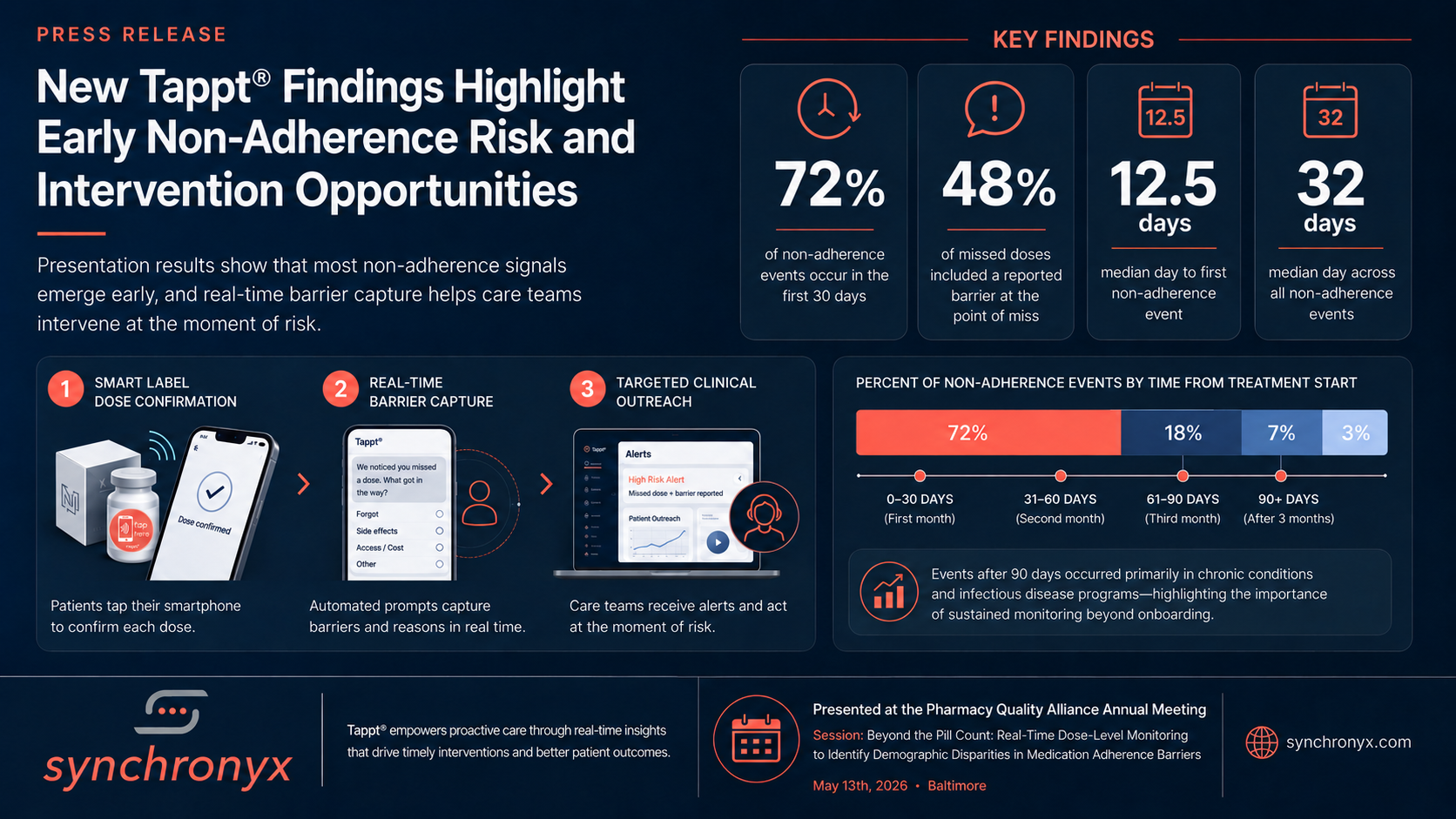
Cross-therapy real-world evidence shows medication adherence barriers surface in the first 30 days — weeks before refill-based monitoring can detect them.
BALTIMORE, MD, UNITED STATES, May 14, 2026 /EINPresswire.com/ — Synchronyx, the medication intelligence company behind the Tappt Health platform, today published new real-world evidence showing that 72% of medication nonadherence events occur within the first 30 days of therapy, with a median first missed dose at day 12.5. The findings, presented at the 2026 Pharmacy Quality Alliance Annual Meeting in Baltimore, challenge a foundational assumption in adherence monitoring: that refill records and pharmacy claims can reliably identify when patients are at risk and why.
The analysis, titled Beyond the Pill Count: Real-Time Dose-Level Monitoring to Identify Demographic Disparities in Medication Adherence Barriers, draws on three years of dose-level data from 277 patients, spanning oncology, inflammatory bowel disease, infectious disease, and chronic conditions. It is among the first studies to characterize real-time medication adherence barriers across multiple disease areas and patient demographics simultaneously.
The Measurement Gap in Medication Adherence
Proportion of Days Covered (PDC) and medication possession ratio (MPR) — the standard adherence metrics used by health plans, specialty pharmacies, and pharma patient support programs — measure whether a prescription was filled, not whether the dose was taken or why it was missed. A refill gap is detectable only after it has already occurred, often weeks after the highest-risk window has closed.
In this three-year cohort, 72% of nonadherence events occurred in the first 30 days of treatment, with a median first missed dose at day 12.5. For specialty pharmacies managing oral oncology patients, for pharma-sponsored patient support programs designed to reduce therapy discontinuation, and for health systems tracking adherence quality measures, this represents a structural blind spot: the period of greatest risk is entirely invisible to conventional monitoring.
What Real-Time Adherence Monitoring Reveals
The Tappt Health medication intelligence platform captures dose-level behavior using battery-free NFC smart labels affixed to medication packaging. When a patient misses a dose, a real-time prompt captures the reason at the moment it occurs, enabling care teams to respond to a specific, identified barrier rather than a supply gap detected weeks later.
In this cohort, 48% of missed doses generated a patient-reported barrier at the point of miss. The reasons span the full clinical spectrum of nonadherence:
Forgetfulness (36.9%) responds to behavioral strategies: reminders and habit-based support. Side effects (13.8%) and medication concerns (4.8%) require clinical dialogue, not a reminder. Provider direction (13.2%) represents physician-ordered dose holds that PDC calculations absorb as adherence failures, overstating the apparent nonadherence rate. Refill and supply failures (6.6%) signal access barriers requiring case management.
These barrier types require different responses. An adherence intervention calibrated to forgetfulness is ineffective for a patient whose nonadherence stems from unresolved medication concerns or an unreported side effect. Real-time, patient-reported data makes the distinction possible.
Demographic Disparities in Medication Adherence
The analysis surfaces health equity signals invisible to aggregate PDC reporting. White patients averaged 94% adherence; Black patients averaged 81% — a 13-point gap. Medicare patients averaged 93% adherence versus 80% for Medicaid patients — a 13-point insurance disparity signaling structural access barriers. Medication concerns were reported 11 times more frequently by Black patients than White patients. These findings directly address the PQA Health Equity Technical Expert Panel’s priority of stratifying adherence quality measures by race, ethnicity, and social determinants of health.
For pharma manufacturers designing branded companion programs and specialty pharmacies managing complex specialty therapy populations, these findings have direct implications: the patients most at risk are least visible to conventional monitoring, and the barriers driving their risk require real-time identification to be actionable.
This is Synchronyx’s second consecutive year presenting at the PQA Annual Meeting. In 2025, the company’s SMART Reach study of real-time adherence monitoring for CDK4/6 inhibitor therapy in breast cancer received the PQA Gold Medal for excellence in medication adherence quality.
About Synchronyx
Synchronyx is a digital health company building the medication intelligence layer for real-world patient journeys. The Tappt Health platform combines battery-free NFC smart labels, a patient companion app, and a care-team monitoring dashboard to give pharma manufacturers, specialty pharmacies, health systems, and clinical trial sponsors real-time visibility into medication behavior between prescription and outcome. Synchronyx is a six-time award winner, including the PQA Gold Medal (2025).
Learn more at www.synchronyx.com.
Media contact: info@synchronyx.com
Tamar Sapir
Synchronyx
email us here
Visit us on social media:
LinkedIn
Instagram
YouTube
Legal Disclaimer:
EIN Presswire provides this news content “as is” without warranty of any kind. We do not accept any responsibility or liability
for the accuracy, content, images, videos, licenses, completeness, legality, or reliability of the information contained in this
article. If you have any complaints or copyright issues related to this article, kindly contact the author above.

Media gallery