Castiglioni Codex: How a Book Is Born
NEW YORK, NY, UNITED STATES, May 14, 2026 /EINPresswire.com/ — Castiglioni Codex: How a Book Is Born
Rooted in the medieval tradition of European manuscript culture, Castiglioni Codex brings the art of the book back to its highest form: paper, image, text, and binding united into a single work of permanence.
The Origins of Castiglioni Codex
Castiglioni Codex is inspired by the great tradition of medieval European manuscripts, when books were created not only to preserve knowledge, but to carry memory, beauty, and meaning across generations. In the monasteries and scriptoria of Europe, each volume was conceived as a unique work: pages were prepared to endure, texts were written with care, images were illuminated by hand, and bindings were crafted to protect the book through time. Centuries later, these works still retain their mystery, authority, and power.
Castiglioni Codex continues this vision. A book is not merely a vehicle for text, but a work of art, a vessel of memory, and a lasting expression of culture, identity, and legacy. To create such a book, three essential elements must come together: paper, image and printing, and binding. Castiglioni Codex approaches each of them with exceptional craftsmanship.
The Paper
Every book begins with its pages. For Castiglioni Codex, paper is not simply a support: it is the foundation of the entire work.The atelier of Luigi Castiglioni, founder of Castiglioni Codex, is located in north-central Italy, near Fabriano, home to one of the world’s oldest and most renowned paper-making traditions. Founded in 1264, Fabriano has preserved a centuries-old heritage of craftsmanship, producing papers admired for their strength, beauty, and durability.
Since its origins, Fabriano has cultivated the art of making fine 100 percent cotton paper with a natural grain. Its surface is not artificially marked or excessively smoothed, but emerges from the production process itself. This gives the paper a living, tactile quality, preserving the presence of the hand, the fiber, and the craft.
The strength, durability, and porous structure of 100 percent cotton paper make it ideal for the refined techniques used in Castiglioni Codex creations: engraving, lithography, xylography, gold printing, and original hand-painted images or decorations.
In a Castiglioni Codex book, paper is never neutral. It is the first material expression of permanence: the surface on which text, image, and memory begin to take form.
The Printing Process
Text and images form the living content of a book. They are the elements through which the page begins to speak, transforming paper into a place of meaning, vision, and memory.
In its recent creations, Castiglioni Codex has chosen letterpress as one of its primary printing techniques. For an upcoming limited edition of ten copies, the atelier will use an 18th-century hand-inked press with movable lead type. This is, in essence, the same printing principle used for the Gutenberg Bible: a slow, physical, and deeply artisanal process in which every page carries the trace of its own making.
The slight imperfections of the ink, the natural pressure of the letters impressed into the paper, and the subtle variations from one sheet to another give each page extraordinary life and vitality. The printed word is no longer flat or anonymous; it becomes a physical presence.
The same mastery is applied to printing in real gold, a technique that the Castiglioni Codex atelier has developed with exceptional refinement. Gold does not simply decorate the page: it catches the light, creates depth, and gives the book a precious, almost ceremonial quality.
Images are approached with the same level of care. At the center of an ecosystem of ateliers preserving historic printing and illustration techniques, Castiglioni Codex is able to incorporate xylography and other complex artistic processes on paper.
In this dialogue between text, image, ink, gold, and paper, the content of a Castiglioni Codex book becomes more than something to be read or seen. It becomes something to be experienced.
The Binding
The final, fundamental phase in the creation of a book is the binding. Bookbinding is not merely a technique, but a complex art form: a long and meticulous process that seals the book for eternity.
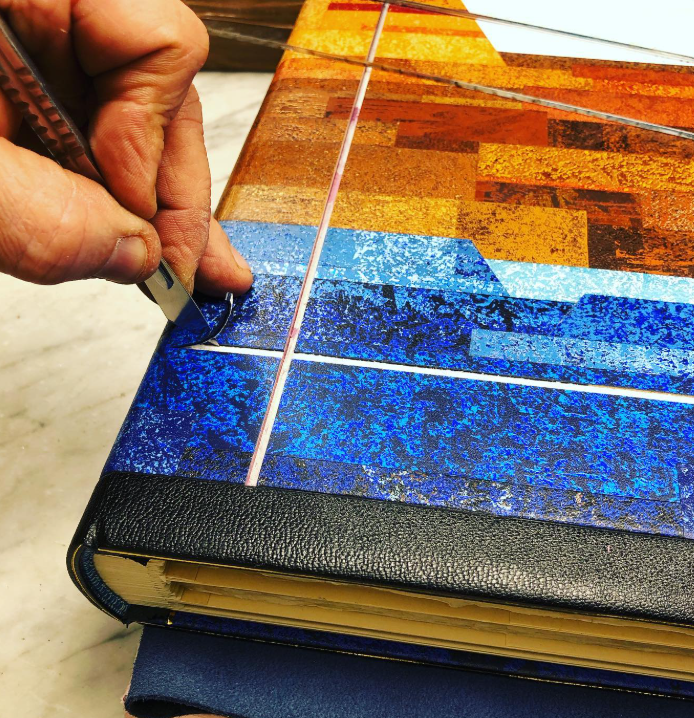
Luigi Castiglioni, master fine binder, personally creates all the bindings for Castiglioni Codex books. The role of the binding is not only to protect the book from the outside world, but also to express, through symbolic form, the meaning of the book itself. Leather mosaics, precious materials, metals, and inlays become part of a refined visual language.
The binding process for a single book can take up to forty days. It begins with the selection of genuine leather from a trusted supplier, followed by the design phase and the gradual construction of the binding, layer by layer, with inlays, precious materials, and metals. The result is a sculptural artwork: an object to be admired, touched, preserved, and understood as the final expression of the book’s inner meaning.
About Castiglioni Codex:
Castiglioni Codex is an Italian atelier specializing in the creation of handmade, one-of-a-kind books of the highest artistic and artisanal quality. Founded by Luigi Castiglioni — Master of Arts and Crafts and head of the Castiglioni family of craftsmen — the house operates from Legatoria Anonima Amanvensis in Rimini, Italy. Each Castiglioni Codex is a bespoke commission, crafted for its owner alone, designed to carry its contents across centuries. Castiglioni Codex is Made in Italy. www.castiglionicodex.com
Media Contact :
Kaleidoscope Luxury PR & Communications Katia Graytok and Thierry Chaunu | New York, NY tchaunu@kaleidoscopeluxury.com | +1 (646) 732-1822
Website /www.kaleidoscopeluxury.com
Katia Graytok
Kaleidoscope Luxury PR & Communications
6467321822 ext.
email us here
Legal Disclaimer:
EIN Presswire provides this news content “as is” without warranty of any kind. We do not accept any responsibility or liability
for the accuracy, content, images, videos, licenses, completeness, legality, or reliability of the information contained in this
article. If you have any complaints or copyright issues related to this article, kindly contact the author above.

Media gallery