Brussels, Belgium — January 31, 2026 – As digital operations become central to global commerce, a growing number of businesses are reassessing where their domain names are registered. Industry observers note an increasing shift toward non-U.S. domain jurisdictions, particularly within the European Union, driven by concerns over the scope and enforcement mechanisms of the U.S. Digital Millennium Copyright Act (DMCA).
In today’s digital economy, a domain name represents more than a technical identifier. It functions as a company’s storefront, communications hub, customer access point, and brand identity. When a domain is suspended or taken offline, businesses can experience immediate disruptions including website outages, email failure, revenue loss, reputational damage, and long-term search visibility impact.
Despite these risks, a large proportion of global businesses continue to rely on U.S.-based domain registrars, placing critical digital assets under U.S. legal frameworks that allow for rapid enforcement actions without prior judicial review.
DMCA Enforcement and Operational Risk
The DMCA was enacted to provide copyright holders with a mechanism to address infringement. However, legal analysts and industry participants have observed that its notice-and-takedown process can result in temporary or prolonged disruptions before claims are fully examined.
Under the DMCA framework, takedown notices can be submitted without court involvement at the initial stage, prompting service providers to act quickly to maintain safe-harbor protections. In practice, this often leads to content or domain suspensions occurring prior to formal verification, with appeals and counter-notices handled afterward.
For affected businesses, this sequence can translate into:
- Temporary or extended domain suspension
- Loss of access to business email systems
- Interrupted customer transactions
- Search engine de-indexing
- Reputational and operational setbacks
Industry groups have raised concerns that this structure may disproportionately impact lawful businesses, particularly those operating in competitive or highly regulated sectors.
Documented Industry Impact
Large-scale DMCA enforcement events have highlighted the potential reach of automated takedown systems. In recent years, mass copyright claims have resulted in widespread content removal across major digital platforms, affecting creators, developers, and businesses alike.
Publicly available data repositories tracking copyright takedown activity indicate that millions of DMCA requests are submitted annually, many through automated systems. Subsequent reviews have shown that a portion of these claims are later disputed, withdrawn, or determined to be non-infringing, underscoring the operational uncertainty faced by affected domain owners during enforcement periods.
Jurisdiction as a Strategic Consideration
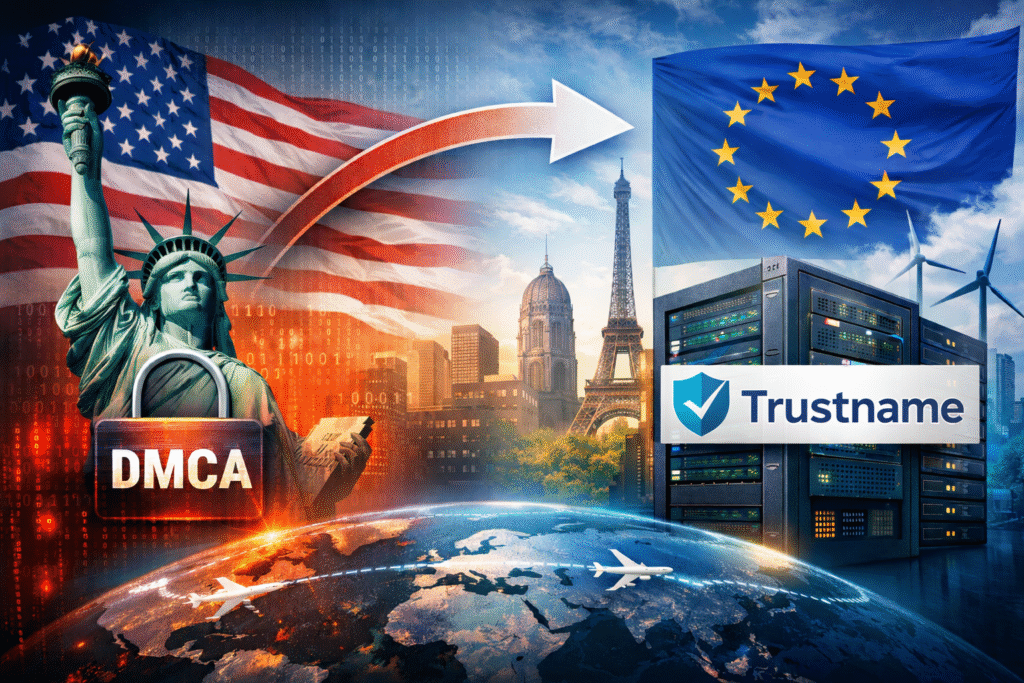
As a result, jurisdiction has become an increasingly important factor in domain governance decisions. Businesses are exploring registrars operating under alternative legal frameworks, particularly within the European Union, where enforcement standards typically require clearer legal grounding and emphasize procedural safeguards.
EU-based registrars operate under European regulatory and judicial systems rather than direct DMCA enforcement. While still compliant with court orders and lawful regulatory requests, these providers generally do not act on automated or anonymous copyright notices without appropriate legal validation.
Industry analysts describe this shift not as an attempt to evade regulation, but as a form of digital risk management aimed at ensuring operational continuity and due process.
Trustname and EU-Based Domain Governance
Trustname is among the registrars operating under European Union jurisdiction, providing domain registration services governed by EU law rather than U.S. DMCA procedures.
According to the company, its policies emphasize due process, legal verification, and jurisdictional clarity. Trustname states that it complies with valid court orders and law enforcement requests while declining to act on unverified or automated copyright complaints lacking legal authority under applicable EU standards.
The company also maintains strict internal policies regarding unlawful activity, including immediate action against fraud, phishing, and deceptive practices, while seeking to protect legitimate businesses from unwarranted disruption.
Businesses Most Affected
Legal and technology consultants note that jurisdictional considerations are particularly relevant for businesses operating in sectors such as:
- Software and SaaS platforms
- Media and digital publishing
- E-commerce and marketplaces
- Blockchain and financial technology
- Health, wellness, and regulated digital services
- Open-source and developer communities
For organizations dependent on continuous uptime and brand trust, domain stability is increasingly viewed as a strategic asset.
About Trustname
Trustname is a European Union–based domain registrar providing domain registration and management services under EU jurisdiction. The company focuses on protecting legitimate digital businesses through transparent policies, due-process-oriented enforcement, and strict compliance with applicable laws and court orders. Trustname maintains a zero-tolerance approach toward fraud, phishing, and deceptive activity while supporting lawful enterprises, developers, and organizations operating in the global digital economy.
Media Inquiries:
pr@trustname.com
Ph +372 688 4747
