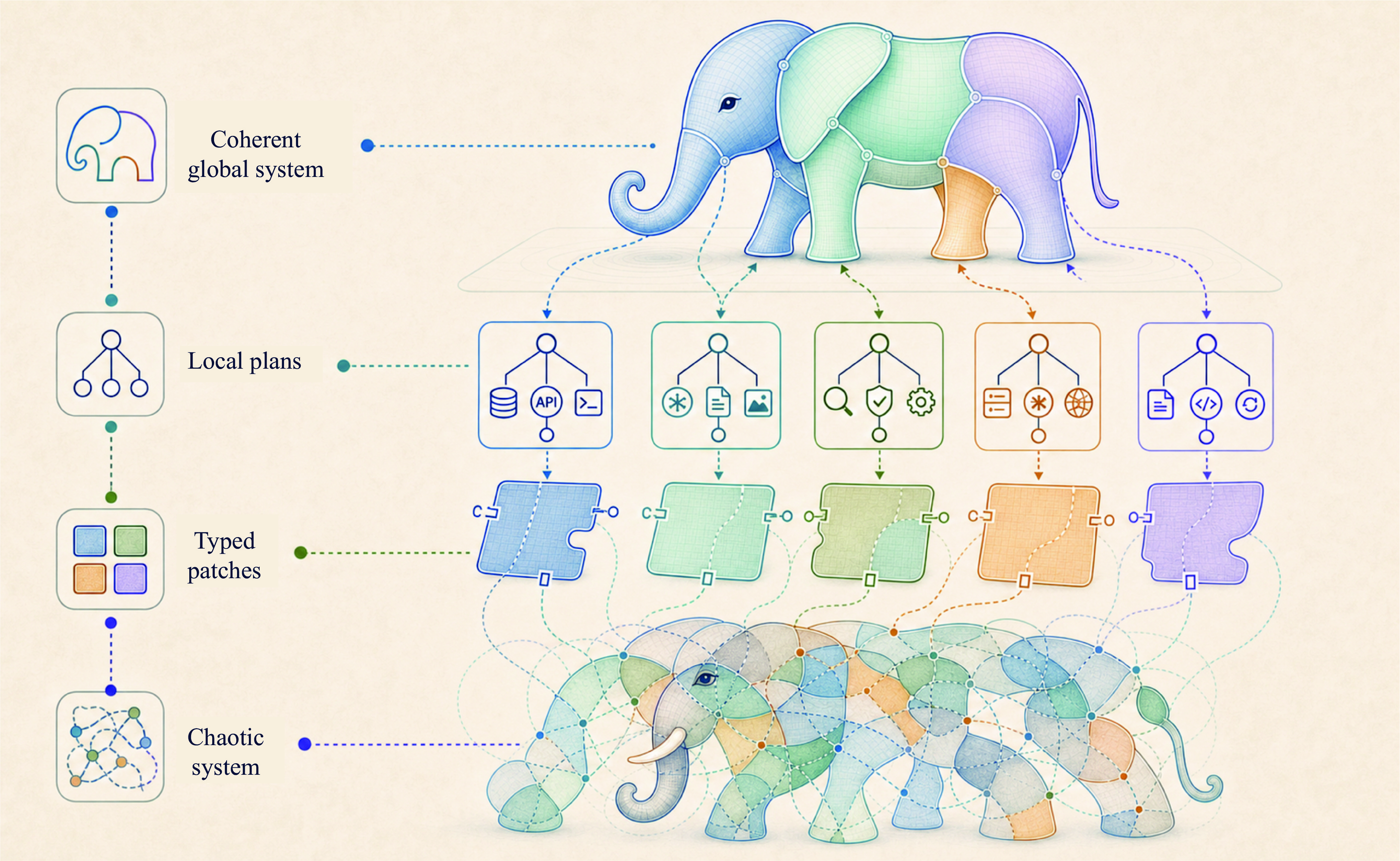

Researchers at Tsinghua University introduce a new mathematical framework that could help future AI systems solve complex tasks more efficiently.
BEIJING, HAIDIAN, CHINA, August 10, 2026 /EINPresswire.com/ — Building smarter artificial intelligence (AI) is becoming increasingly challenging as AI systems are expected to handle more complicated tasks with less human supervision. Now, researchers from Tsinghua University have developed a new approach that tackles this challenge by breaking large problems into smaller, more manageable pieces.
Published in the journal iFuture, the new framework, called the Calculus of Intelligence (COIN), offers a structured way to design and organise advanced AI systems. The approach is inspired by the well-known saying, “How do you eat an elephant? One bite at a time.” Instead of trying to solve one massive problem at once, COIN divides it into many smaller tasks that can be solved individually before being combined into a complete solution.
“Complex problems don’t always need complex solutions,” said Yang Yuan, Associate Professor at the Institute for Interdisciplinary Information Sciences (IIIS), Tsinghua University, and the study’s corresponding author. “Our framework shows that by organising problems into smaller, well-defined parts, AI systems can become easier to build, understand and verify.”
The researchers compare the idea to building an aircraft. Different engineering teams work on the wings, engines and control systems independently, but each follows shared design rules so that every part fits together correctly. COIN applies the same principle to AI, allowing different AI components to solve individual tasks while working together as one coordinated system.
Behind the scenes, the framework uses advanced mathematics to organize how these smaller tasks connect. While the mathematics is sophisticated, its goal is simple: make it easier to develop reliable AI systems that can handle increasingly complex real-world challenges. The researchers believe this approach could support the next generation of agentic AI, AI systems that can perform tasks with minimal human supervision, such as writing software, analysing data, improving cybersecurity, managing workflows and assisting with scientific research.
Rather than relying on a single, all-powerful AI model, COIN supports the idea of many specialized AI systems working together. According to the researchers, this could make future AI more scalable, dependable and easier to manage.
About the Research team:
The research was co-authored by Andrew Chi-Chih Yao, Professor and Dean of IIIS at Tsinghua University. Both researchers are also affiliated with the Shanghai QiZhi Institute. The study, “Calculus of Intelligence”, was published on 17 July in iFuture, an open-access journal published by Tsinghua University Press. The journal focuses on advancing the theoretical foundations and future development of artificial intelligence.
Read the full article here: sciopen.com/article/10.26599/IF.2026.9710001
About iFuture:
iFuture is a premier open-access journal published by Tsinghua University Press on the SciOpen platform, with academic support from the Institute for Interdisciplinary Information Sciences at Tsinghua University. Led by Turing Award Laureate Prof. Andrew Chi-Chih Yao as Editor-in-Chief, the journal is the core component of the AI Open Alliance. Its core mission is to break through AI’s theoretical bottlenecks and foundational infrastructure.
Andrew Smith
Charlesworth Yansci
+ +44 7478 953600
marketing@charlesworth-group.com
Visit us on social media:
Bluesky
X
Other
Legal Disclaimer:
EIN Presswire provides this news content “as is” without warranty of any kind. We do not accept any responsibility or liability
for the accuracy, content, images, videos, licenses, completeness, legality, or reliability of the information contained in this
article. If you have any complaints or copyright issues related to this article, kindly contact the author above.

Media gallery