
Rimma Bondarenko // Shutterstock
9 million Americans on appetite-suppressing drugs are reshaping what protein sales look like on Amazon
GLP-1 medications created the largest protein demand shock in a generation, and they did it by making people eat less.
Over 9 million Americans are now on Ozempic, Wegovy, Mounjaro, or a competitor. Clinical research shows that 25%-40% of the weight lost on these drugs comes from lean mass rather than fat. A study presented at the Endocrine Society’s annual meeting put the figure at roughly 40% for semaglutide users. The clinical response is now standard: 1.2 to 1.6 grams of protein per kilogram of body weight daily, roughly 90 to 120 grams for most adults, plus resistance training, to protect muscle during treatment.
At the same time, appetite falls by 30%-50%.
That collision is the entire story. Millions of people were handed a protein target higher than they’ve ever hit, at the exact moment their capacity to eat collapsed. Every one of them became a shopper with an unusual and very specific set of constraints. SmartScout examined data from the U.S. Amazon marketplace covering the 12 months leading up to August 2026, which shows Amazon’s protein shelf reorganizing around those constraints in real time.
The Muscle Defense Signal Is the Clearest in the Dataset
The first thing a GLP-1 user hears is that they will lose muscle unless they intervene. The commerce response to that warning is already massive, and the biggest signal isn’t protein.
Creatine generates $720.8 million in annual revenue on Amazon, growing 90% year over year. The search term “creatine” draws 620,729 monthly searches and is up in every single tracking window SmartScout measures. Nothing else in this analysis grows in all four. Creatine is the most evidence-backed muscle preservation supplement analyzed for this study, and it’s now standard in GLP-1 lean mass protocols.
Protein powder tracks alongside it at 603,335 monthly searches, up 59,279 year over year.
This is the purest GLP-1 signal on Amazon: not weight loss products, but muscle defense products.
Liquid Is Winning the Smaller Stomach
A 30%-50% appetite reduction turns volume into the binding constraint. The question stops being “how many calories” and becomes “how much protein fits before I physically cannot continue.”
Liquid wins that math, and the data is unambiguous.
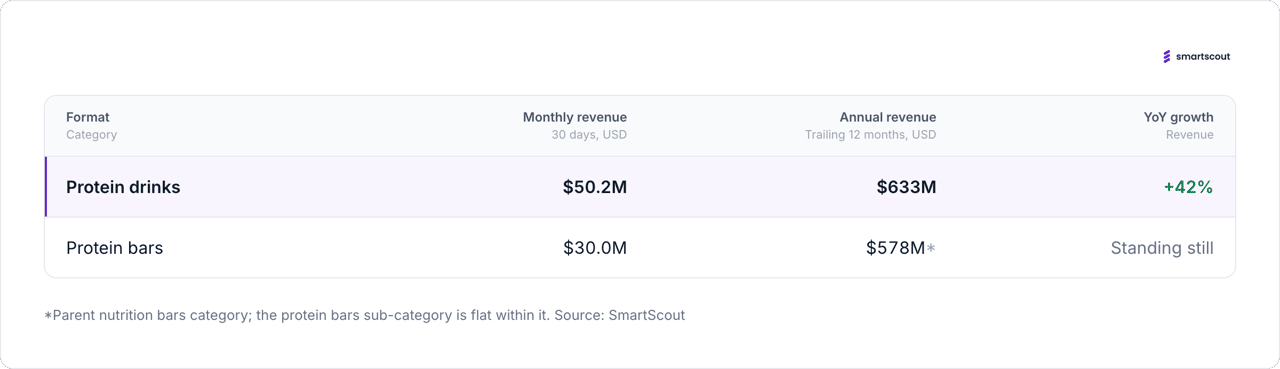
SmartScout
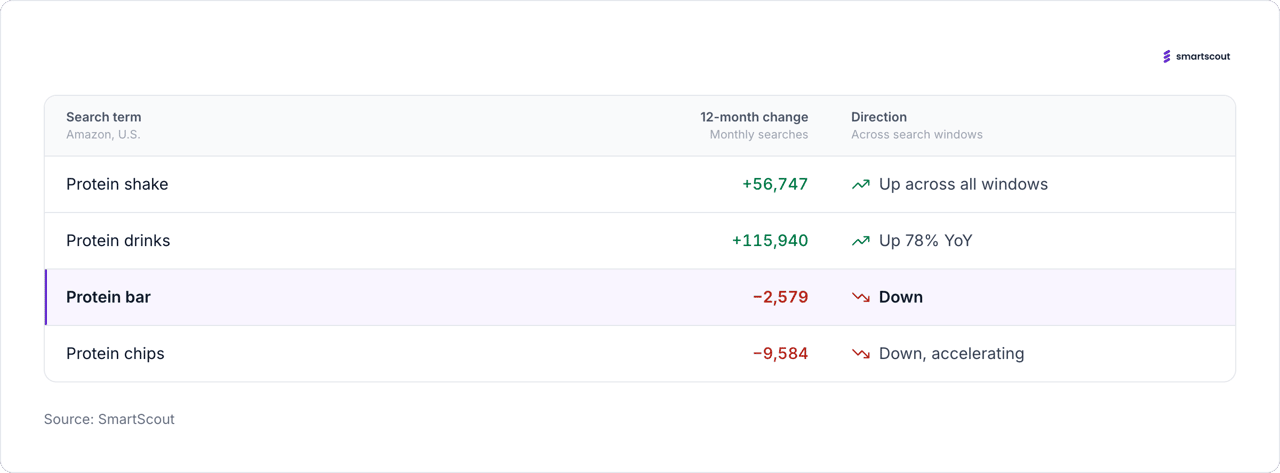
The search data tells the same story, only sharper:
SmartScout
Liquid gained roughly 57,000 searches over 12 months, while solid lost 2,600.
Ready-to-drink protein is the format that answers the volume constraint: 30 grams, no chewing, no satiety penalty, and tolerable when nauseated. Core Power and Premier Protein now split 55% of that category, and each spends around 15% of its ad dollars defending the position. That’s why “protein drinks” costs $9.72 per click while cottage cheese costs 70 cents.
The Protein Bar’s Real Problem Isn’t the Format but the Ingredients
This is the constraint the industry has not priced in, and it’s where the protein bar breaks.
GLP-1 drugs work partly by slowing gastric emptying. The documented consequences are nausea, constipation, bloating, and reflux. Everything downstream slows with it.
Sugar alcohols are the standard tool for making a high-protein bar taste sweet without sugar. They’re also a well-documented cause of bloating, gas, and GI distress in people with normal digestion. For someone whose stomach is already emptying at half speed, they’re a trigger.
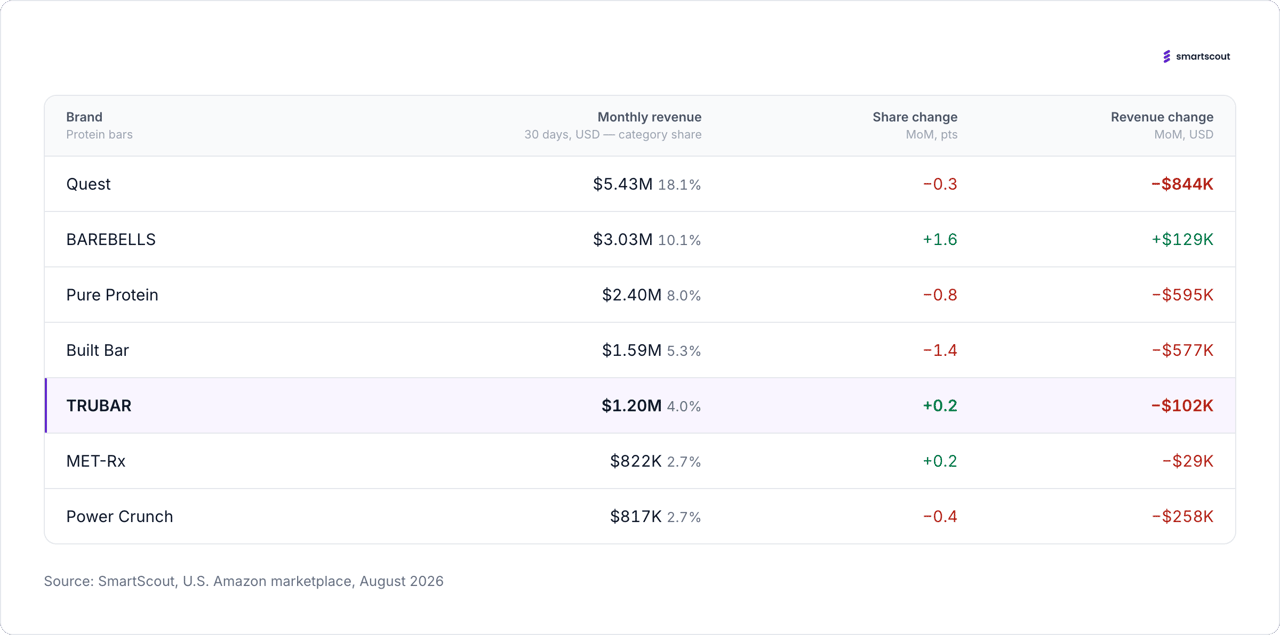
The brand leaderboard reflects exactly that:
SmartScout
Of the top 12 protein bar brands by revenue, 10 lost revenue month over month.
And the one brand taking meaningful share is doing something that should not work on paper.
The Brand Winning the Protein Bar Shelf Has 40% Less Protein
TRUBAR is gaining share with 12 grams of protein per bar against Quest’s roughly 20. TRUBAR has 40% less of the nutrient that the entire category competes on.
What TRUBAR’s product titles instead repeatedly lead with is “No Sugar Alcohols,” alongside 12 grams of fiber. Its top listings rate ranges from 4.3 to 4.8, compared with a category average of 4.22.
A brand is taking share by offering less protein and better tolerability. That only makes sense if the marginal buyer’s binding constraint is their gut, not their macros. That is a GLP-1 buyer.
Fiber tells a parallel story: “Fiber supplement” draws 158,468 monthly searches and jumped 28,689 in the most recent month, consistent with a population managing constipation as a treatment side effect.
Real Food Is Beating Engineered Food, and the Ad Auctions Are Still Empty
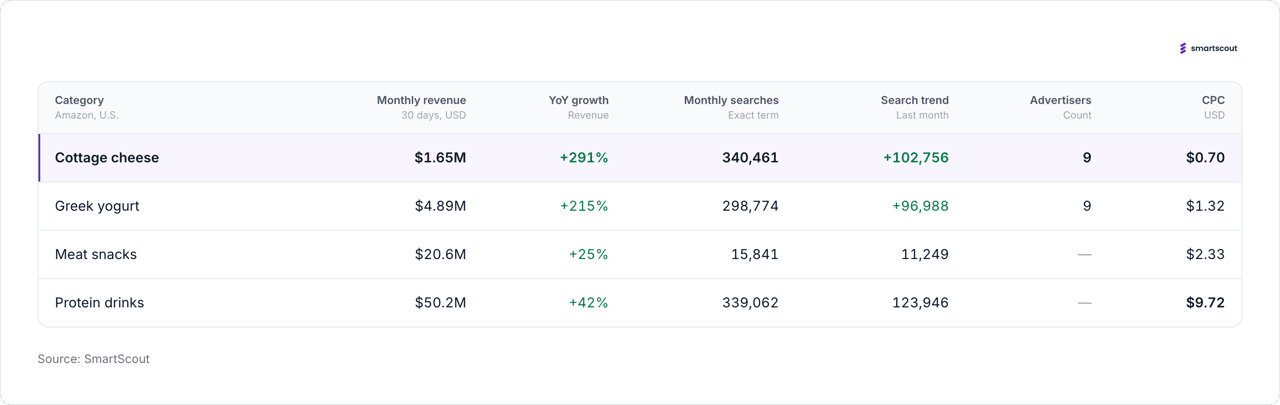
When someone eats three times a day instead of six, each occasion carries more weight. In the search data, GLP-1 users are gravitating toward things that read as food rather than supplementation.
SmartScout
Those cottage cheese and Greek yogurt numbers deserve a second look. Each added roughly 100,000 searches in a single month. Each has just nine advertisers. Each costs under $1.35 per click, while protein drinks cost $9.72. Cold chain logistics are harder, which is why the auction is still empty.
Good Culture turned cottage cheese from a 1950s diet food into a protein brand and now holds 33.7% of the Amazon category with just seven products. Chomps overtook Jack Link’s in jerky, $3.46 million against $3.3 million monthly, using 59 products against Jack Link’s 215. Both are real food, clean label, and built for a shopper reading a macro target rather than browsing a snack aisle.
Inside the Bar Aisle, Growth Is Everywhere Except the Protein Bar Shelf
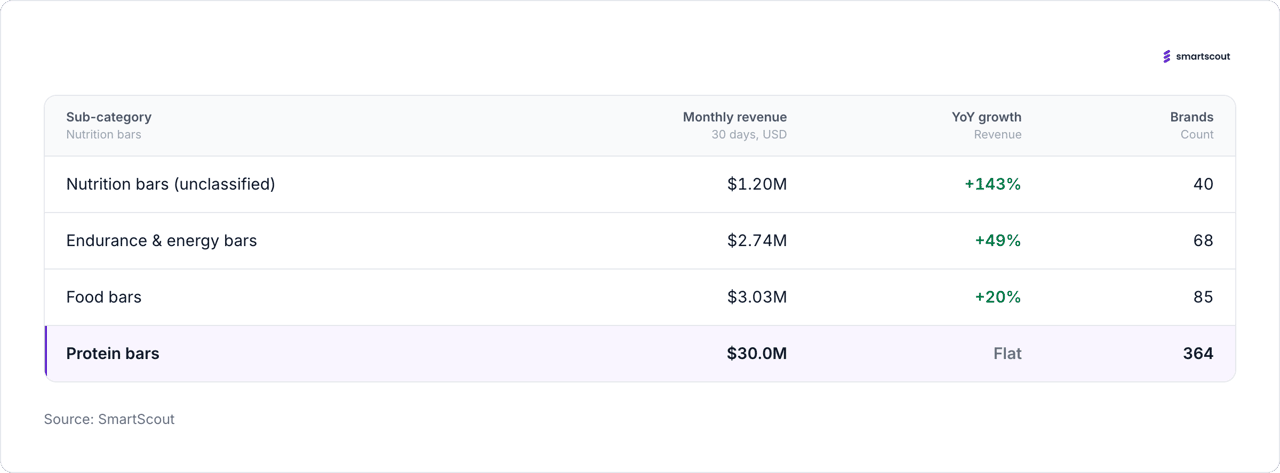
Put those constraints together, and the protein bar should be the defining product of the GLP-1 era. It has concentrated protein, is shelf-stable, requires no preparation, and is portion-controlled. Instead, the growth inside Amazon’s bar aisle is routing around the main shelf entirely.
SmartScout
Protein Bars is the largest subcategory by a wide margin, the most crowded (364 brands, 2,882 products, averaging 612 sellers per listing), and the only one not moving. The sparse formats are compounding at double and triple-digit rates. The dominant one is standing still.
The Brand that Understood: Protein Donuts Outselling Protein Bars
Legendary Foods is the largest share gainer in Food Bars, adding 6.3 points of share and roughly $194,000 in monthly revenue in a single month. It sells high-protein cinnamon pastries at $186,000 per month, chocolate pastries at $154,000, strawberry pastries at $130,000, cinnamon rolls at $100,000, and protein donuts that rank number one in Amazon’s Donuts subcategory outright.
Its ratings sit between 3.9 and 4.2, below the category average. It’s winning because, to someone eating three small meals a day with reduced appetite and shifting taste preferences, a protein donut is food and a protein bar is a supplement. It’s the same macros, but an entirely different proposition.
The Tell: Nobody Is Searching For the Drug
The Amazon search term “glp 1” draws 27,725 monthly searches and is down roughly 4,900 year over year.
That may be the most useful number in this entire analysis. The GLP-1 commerce wave is not visible in GLP-1 searches. Shoppers are typing creatine, protein shake, cottage cheese, and Greek yogurt into Amazon rather than the names of medications. The brands capturing them are the ones that solved for the physiology without ever naming the cause.
What Smartscout’s Data Adds Up to
The signals across the dataset point in one direction:
- Build for the constraint, not the macro. The GLP-1 shopper is short on appetite, volume, and gut tolerance rather than convenience. Every category winning right now solves one of those three. Every category losing is optimized for grams per dollar.
- Tolerability is wide-open positioning. TRUBAR is gaining share with 40% less protein and a “no sugar alcohols” claim. No major incumbent is competing on gastrointestinal comfort for a population of millions who now need it most.
- Format is beating formulation. Legendary Foods grew by putting protein into pastries and donuts. Inside the bar family, the fastest-growing subcategories are the ones not called protein bars.
- The cheap traffic is refrigerated. Cottage cheese and Greek yogurt each draw roughly 300,000 monthly searches with under 10 advertisers and CPCs below $1.35. Protein drinks cost $9.72. Cold chain is harder. That’s why the opportunity is still sitting there.
- Never name the drug. Searches for “glp 1” on Amazon are falling. The brands winning are answering the symptom.
Protein has never sold better on Amazon. The protein bar missed the wave, because it was engineered for an appetite that 9 million of its best prospective customers no longer have.
This story was produced by SmartScout and reviewed and distributed by Stacker.

