
WUHAN, HUBEI, CHINA, August 24, 2026 /EINPresswire.com/ — The global manufacturing landscape is currently undergoing a transformative phase where the traditional boundaries of production efficiency are being redrawn. As consumer demand fluctuates and product lifecycles shorten, industrial players are no longer just looking for faster machines; they are seeking integrated ecosystems. For sectors relying on high-volume sheet metal fabrication—a process characterized by the mass production of metal components through cutting, bending, and assembling—the pressure to balance rapid output with high precision has never been greater.
The Paradigm Shift in Global Sheet Metal Processing
In the past, sheet metal fabrication relied heavily on standalone workstations. A high-power laser cutter would operate as an isolated “island” of productivity. While the machine itself might be fast, the overall throughput was frequently throttled by manual processes: forklift drivers moving heavy pallets, operators manually sorting cut parts, and the inevitable downtime during material changeovers. This “siloed” production model has become a significant bottleneck in the era of Industry 4.0.
Today, high-volume sheet metal fabrication requires a holistic approach. It is no longer sufficient to optimize the cutting speed alone. True efficiency is found in the seamless flow of data and material from the initial raw sheet to the finished part. This realization has led to a paradigm shift toward “Smart Factory” innovations, where companies like HGTECH are leading the charge by integrating laser technology with advanced automation to eliminate structural inefficiencies.
Core Pillars of HGTECH’s Smart Factory
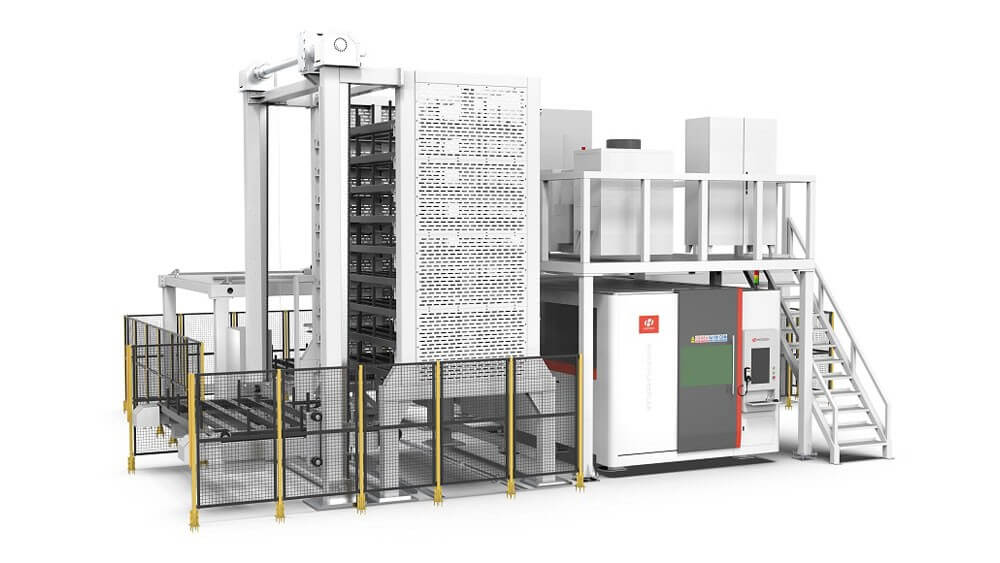
To understand how a modern facility achieves high-volume output, one must look at the physical architecture of the smart factory. HGTECH has developed a multi-tiered ecosystem that synchronizes hardware and logistics to ensure the laser source is utilized to its maximum potential.
1. High-Performance Cutting Systems
The engine of any fabrication line is the laser cutting system. In high-volume environments, dynamic performance and thermal stability are critical. HGTECH’s heavy equipment automation product line offers two flagship large-format series: the WALC-F Series (Standard) and the WALC-Q Series (Light Weight). Both series are powered by high-power fiber lasers ranging from 6,000W to 30,000W, supplied by Wuhan Raycus — the domestic market leader in high-power fiber lasers. The WALC-F Series delivers a maximum acceleration of 0.6G with a single-axis top speed of 40m/min, while the more agile WALC-Q Series achieves 0.8G acceleration and a composite maximum speed of 84m/min, enabling fast, high-precision cutting across a wide range of materials. Both series are capable of vertically cutting carbon steel up to 80mm thick and stainless or aluminum steel up to 100mm thick. Each machine is equipped with an intelligent cutting head featuring automatic focusing, anti-collision protection, full lens pressure monitoring, and real-time remote observation of cutting status — ensuring consistent edge quality while significantly reducing the need for secondary finishing.
2. Integrated Control and Automation Readiness
A significant productivity advantage comes from HGTECH’s self-developed HMI (Human-Machine Interface) software platform. This cutting control system provides practical features including production task management, material inventory management, and a built-in simplified graphic library for rapid part generation without programming. Critically, the system is designed with open integration capability: it can be customized to incorporate control of automated loading, unloading, and slag removal equipment, while displaying cutting paths in real time. This openness means the cutting cell can serve as the core node of a wider automated production line, minimizing manual intervention and supporting continuous, high-efficiency operation.
3. Intelligent Software and Process Management
A smart factory depends as much on data management as on physical throughput. HGTECH’s cutting systems are supported by a comprehensive process database that allows operators to create, save, modify, and export cutting parameters for different materials and thicknesses — covering settings for piercing, cutting, lead-in and lead-out lines, and gas type selection. The HMI task management module supports batch import and deletion of programs, real-time editing, visual preview of cutting programs, and detailed display of material type, plate thickness, and plate dimensions. For bevel cutting applications, compatible nesting software options — including Sigma, Lantek, and HGTECH’s own HGNest — further optimize material utilization and program generation, helping to reduce waste and improve per-part economics across high-volume production runs.
The Brain: Software and Digital Integration
If the hardware represents the muscle of the smart factory, the software is undoubtedly the brain. The transition to a laser automation solution for high-volume sheet metal fabrication is incomplete without a robust digital backbone that connects the factory floor to the front office. By interfacing with existing Enterprise Resource Planning (ERP) and Manufacturing Execution Systems (MES), the smart factory can receive orders, schedule production, and report progress in real-time.
One of the most impactful software features is intelligent nesting optimization. Advanced algorithms calculate the most efficient layout of parts on a sheet of metal, often achieving material utilization rates that manual nesting cannot match. In high-volume production, even a minor increase in material yield translates directly into significant annual cost savings. Furthermore, remote monitoring and predictive maintenance modules analyze data from sensors within the laser and automation components. By identifying wear patterns or cooling issues before they cause a breakdown, the system ensures that high-volume lines remain operational without unexpected interruptions.
Industry Applications: From Automotive to Heavy Machinery
The versatility of automated laser solutions allows them to be deployed across diverse high-stakes industries, each with unique requirements.
Automotive Industry: The demand for Body-in-White (BIW) components requires high-frequency processing of high-strength steel. Automated lines allow for the rapid production of structural parts with zero-defect consistency, meeting the rigorous safety standards of the global automotive supply chain.
Heavy Construction Machinery: Fabricating thick plates for excavators or cranes presents challenges in material handling. Heavy-load lifting systems and specialized fiber lasers enable the automated processing of large-format sheets, reducing the reliance on heavy-duty forklifts and manual labor.
Elevator and Home Appliances: These sectors are characterized by high variety and medium-to-high volumes. Smart factory configurations allow for rapid switching between different part geometries and material types without retooling, facilitating “just-in-time” manufacturing strategies.
Economic Impact and Long-term Strategic Value
Investing in a comprehensive laser automation solution is a strategic financial decision that extends far beyond the initial purchase of a machine. The return on investment is realized through a dramatic increase in total throughput; by eliminating the “waiting time” between batches, an automated system can often outperform multiple standalone machines, providing a much higher output per square meter of factory space. Furthermore, automation reallocates human talent from repetitive, dangerous lifting tasks to higher-value roles such as system programming and quality oversight, which optimizes labor costs and reduces the risk of workplace incidents. This efficiency is bolstered by the improved material yield provided by intelligent software, which directly lowers the cost per part. For international manufacturers, this value is secured by a global service network that provides localized technical support and spare parts, ensuring that the technological advantages of the smart factory are backed by the security of rapid maintenance response and minimal downtime.
Conclusion: Embracing the Future of Metal Fabrication
The shift toward fully automated, digitally integrated production is no longer a luxury reserved for the world’s largest corporations. For any enterprise involved in high-volume sheet metal fabrication, automation has become a fundamental requirement for survival in a competitive global market.
As the pioneer of laser industrial applications in China and a global leader in intelligent manufacturing, HGTECH continues to refine the synergy between “Laser + Intelligent Manufacturing.” By focusing on the integration of automation, informatization, and intelligence, the company is helping manufacturers transition from isolated processes to interconnected, high-efficiency ecosystems. The future of the industry lies in these smart factory innovations, where laser technology serves as the catalyst for a more efficient, sustainable, and responsive manufacturing world.
For more information on intelligent manufacturing solutions, visit: https://www.hglaserglobal.com/
Wuhan HGLaser Engineering Co.,Ltd
Wuhan HGLaser Engineering Co.,Ltd
+86 2787180225
email us here
Visit us on social media:
LinkedIn
Instagram
Facebook
YouTube
TikTok
X
Legal Disclaimer:
EIN Presswire provides this news content “as is” without warranty of any kind. We do not accept any responsibility or liability
for the accuracy, content, images, videos, licenses, completeness, legality, or reliability of the information contained in this
article. If you have any complaints or copyright issues related to this article, kindly contact the author above.

Media gallery