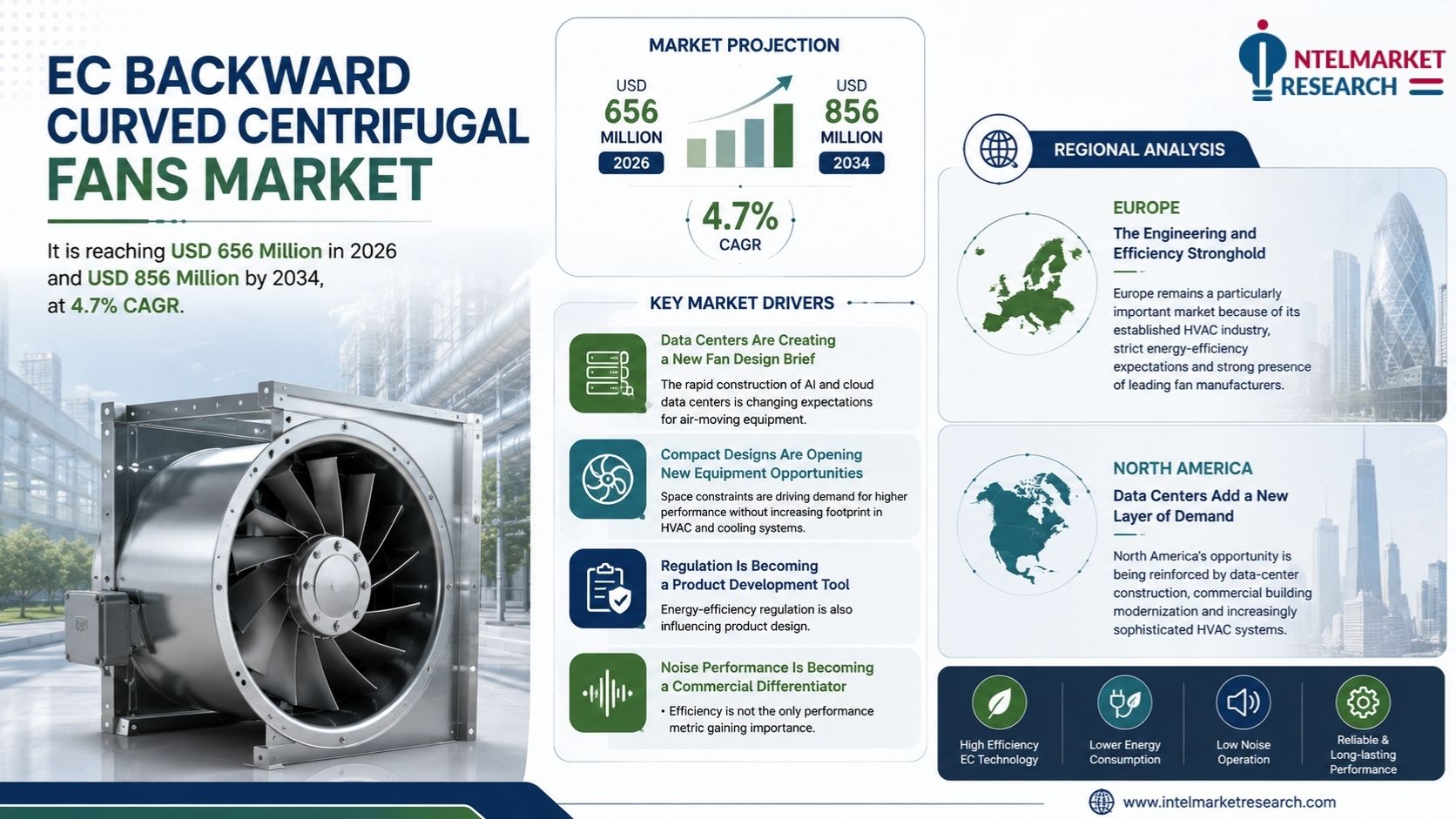

EC Backward Curved Fans Market will grow from USD 656 Million in 2026 to USD 856 Million by 2034 at a 4.7% CAGR, driven by smarter, efficient HVAC.
PUNE, MAHARASHTRA, INDIA, August 27, 2026 /EINPresswire.com/ — EC Backward Curved Centrifugal Fans Market is entering a new phase as HVAC manufacturers, data center operators and industrial facility owners place greater emphasis on energy consumption, controllability and equipment efficiency. Unlike conventional AC-driven fan systems, electronically commutated motors can provide variable-speed operation and more precise airflow management, allowing equipment designers to match fan output with real-time demand.
The shift is particularly relevant as cooling and ventilation systems become more sophisticated. Modern buildings increasingly use sensors, automation and building-management platforms to adjust airflow according to occupancy, temperature and equipment load.
𝐖𝐡𝐲 𝐁𝐚𝐜𝐤𝐰𝐚𝐫𝐝 𝐂𝐮𝐫𝐯𝐞𝐝 𝐆𝐞𝐨𝐦𝐞𝐭𝐫𝐲 𝐈𝐬 𝐖𝐢𝐧𝐧𝐢𝐧𝐠 𝐀𝐭𝐭𝐞𝐧𝐭𝐢𝐨𝐧?
Backward curved centrifugal fans are valued for their ability to generate substantial airflow and pressure while maintaining favorable efficiency characteristics. Their blade geometry also supports stable operation across a broad operating range.
When combined with EC motors, the fan becomes more than an airflow-generating component. Speed can be adjusted electronically, helping systems avoid the unnecessary energy consumption associated with operating continuously at full capacity.
This combination is creating opportunities in air-handling units, precision cooling equipment, ventilation systems, refrigeration equipment and industrial air movement.
➣ According to 𝗜𝗻𝘁𝗲𝗹𝗠𝗮𝗿𝗸𝗲𝘁𝗥𝗲𝘀𝗲𝗮𝗿𝗰𝗵 latest studies, EC Backward Curved Centrifugal Fans Market was valued at 𝗨𝗦𝗗 𝟲𝟮𝟳 𝗠𝗶𝗹𝗹𝗶𝗼𝗻 𝗶𝗻 𝟮𝟬𝟮𝟱, reaching 𝗨𝗦𝗗 𝟲𝟱𝟲 𝗠𝗶𝗹𝗹𝗶𝗼𝗻 𝗶𝗻 𝟮𝟬𝟮𝟲 and 𝗨𝗦𝗗 𝟴𝟱𝟲 𝗠𝗶𝗹𝗹𝗶𝗼𝗻 𝗯𝘆 𝟮𝟬𝟯𝟰, at 𝟰.𝟳% 𝗖𝗔𝗚𝗥.
💠𝐀𝐜𝐜𝐞𝐬𝐬 𝐭𝐡𝐞 𝐋𝐚𝐭𝐞𝐬𝐭 𝐈𝐧𝐬𝐢𝐠𝐡𝐭𝐬 𝐟𝐫𝐨𝐦 𝐎𝐮𝐫 𝐍𝐞𝐰𝐥𝐲 𝐑𝐞𝐥𝐞𝐚𝐬𝐞𝐝 𝐒𝐚𝐦𝐩𝐥𝐞 𝐑𝐞𝐩𝐨𝐫𝐭: https://www.intelmarketresearch.com/download-free-sample/40732/ec-backward-curved-centrifugal-fans-market-market
𝐄𝐂 𝐌𝐨𝐭𝐨𝐫𝐬 𝐀𝐫𝐞 𝐂𝐡𝐚𝐧𝐠𝐢𝐧𝐠 𝐭𝐡𝐞 𝐄𝐜𝐨𝐧𝐨𝐦𝐢𝐜𝐬 𝐨𝐟 𝐅𝐚𝐧 𝐎𝐩𝐞𝐫𝐚𝐭𝐢𝐨𝐧
The most important transition is taking place at the motor level.
• Traditional fixed-speed systems often rely on mechanical controls such as dampers to regulate airflow. EC technology allows the motor itself to vary speed, reducing the need to waste energy by restricting airflow after the fan has already generated it.
• The U.S. Department of Energy has highlighted the importance of variable-speed technologies in reducing motor-system energy consumption, while the European Union’s Ecodesign framework continues to push manufacturers toward higher efficiency across electrically driven equipment.
• For facility owners operating thousands of hours annually, even relatively small improvements in fan-system efficiency can translate into meaningful operating-cost savings.
𝐃𝐚𝐭𝐚 𝐂𝐞𝐧𝐭𝐞𝐫𝐬 𝐀𝐫𝐞 𝐂𝐫𝐞𝐚𝐭𝐢𝐧𝐠 𝐚 𝐍𝐞𝐰 𝐅𝐚𝐧 𝐃𝐞𝐬𝐢𝐠𝐧 𝐁𝐫𝐢𝐞𝐟
The rapid construction of AI and cloud data centers is changing expectations for air-moving equipment.
AI servers generate significantly greater heat loads than conventional computing equipment, creating additional demand for sophisticated thermal-management infrastructure. The International Energy Agency estimates that global data-center electricity consumption could more than double by 2030, reaching around 𝟵𝟰𝟱 𝗧𝗪𝗵, with AI acting as a major contributor to the increase.
While liquid cooling is expanding rapidly, air-based cooling remains important for heat rejection, room ventilation, and air handling and hybrid thermal architectures.
EC backward curved centrifugal fans can benefit from this transition because operators increasingly want cooling systems that can respond dynamically to fluctuating computational loads rather than operate continuously at maximum output.
𝐂𝐨𝐦𝐩𝐞𝐭𝐢𝐭𝐢𝐯𝐞 𝐀𝐧𝐚𝐥𝐲𝐬𝐢𝐬
The competitive landscape is led by established ventilation specialists with deep expertise in motors, impellers, controls and complete air-moving systems. However, the basis of competition is changing as customers increasingly evaluate total system performance rather than fan output alone.
The competitive field also includes;
🔸ebm papst
🔸Soler & Palau Ventilation Group
🔸Ziehl Abegg
🔸Rosenberg Ventilatoren
🔸Infinair
🔸Blauberg
🔸AFL Motors
🔸PBM
🔸PSC Motor and Fan
🔸Seemtek
🔸Sofasco
🔸Systemair
🔸Longwell Group
🔸Nicotra Gebhardt
🔸Ningbo Jiulong Telecommunication & Electrical Machinery
Where Suppliers Are Trying to Differentiate;
Suppliers are increasingly differentiating through energy-efficient EC motors, aerodynamically optimized impellers, low-noise performance, integrated electronic controls, IoT connectivity, thermal-management capabilities, compact designs, and OEM-specific customization.
This is particularly important in data-center cooling, where fans operate continuously and even small efficiency gains can create significant energy savings over time. As a result, competitive advantage is shifting from standalone fan products to complete, intelligent airflow solutions.
💠𝐁𝐫𝐨𝐰𝐬𝐞 𝐎𝐮𝐫 𝐓𝐡𝐨𝐫𝐨𝐮𝐠𝐡 𝐑𝐞𝐥𝐚𝐭𝐞𝐝 𝐒𝐞𝐜𝐭𝐨𝐫-𝐖𝐢𝐬𝐞 𝐒𝐭𝐮𝐝𝐢𝐞𝐬: https://www.intelmarketresearch.com/ec-backward-curved-centrifugal-fans-market-market-40732
𝐒𝐞𝐠𝐦𝐞𝐧𝐭 𝐀𝐧𝐚𝐥𝐲𝐬𝐢𝐬
◘ 𝐁𝐲 𝐓𝐲𝐩𝐞 | 𝟐𝟎𝟎-𝟑𝟎𝟎 𝐦𝐦 𝐁𝐞𝐜𝐨𝐦𝐞𝐬 𝐭𝐡𝐞 𝐏𝐫𝐚𝐜𝐭𝐢𝐜𝐚𝐥 𝐃𝐞𝐬𝐢𝐠𝐧 𝐒𝐰𝐞𝐞𝐭 𝐒𝐩𝐨𝐭
• Impeller Diameter 100-200 mm
• Impeller Diameter 200-300 mm (Preferred Mid-Range Configuration)
• Impeller Diameter 300-400 mm
• Others
The 200-300 mm category offers a useful balance between compact equipment design and meaningful airflow capacity. It fits naturally into many HVAC modules and air-handling systems while giving OEMs enough flexibility to optimize pressure and efficiency.
Backward-curved blades also help maintain stable aerodynamic performance, while EC motors allow the same fan to respond to changing load conditions through variable-speed control.
𝗦𝗲𝗴𝗺𝗲𝗻𝘁 𝘁𝗮𝗸𝗲𝗮𝘄𝗮𝘆: The 200-300 mm range is gaining preference where equipment designers need compact dimensions without sacrificing airflow and pressure performance.
◘ 𝐁𝐲 𝐀𝐩𝐩𝐥𝐢𝐜𝐚𝐭𝐢𝐨𝐧 | 𝐇𝐕𝐀𝐂 𝐑𝐞𝐦𝐚𝐢𝐧𝐬 𝐭𝐡𝐞 𝐄𝐯𝐞𝐫𝐲𝐝𝐚𝐲 𝐖𝐨𝐫𝐤𝐡𝐨𝐫𝐬𝐞
• HVAC Systems (Largest Application Base)
• Air Handling Units
• Refrigeration Equipment
• Others
HVAC systems remain the broadest application because commercial and residential buildings require continuous air circulation, ventilation and temperature management. EC motors add another advantage by allowing airflow to be adjusted instead of keeping fans at a fixed operating speed.
This becomes particularly valuable in offices, hospitals, retail facilities and institutional buildings where demand changes throughout the day.
𝗦𝗲𝗴𝗺𝗲𝗻𝘁 𝘁𝗮𝗸𝗲𝗮𝘄𝗮𝘆: HVAC systems maintain the strongest application position because EC technology combines efficient air movement with the variable-speed control increasingly demanded by modern buildings.
◘ 𝐁𝐲 𝐄𝐧𝐝 𝐔𝐬𝐞𝐫 | 𝐂𝐨𝐦𝐦𝐞𝐫𝐜𝐢𝐚𝐥 𝐁𝐮𝐢𝐥𝐝𝐢𝐧𝐠𝐬 𝐂𝐫𝐞𝐚𝐭𝐞 𝐭𝐡𝐞 𝐁𝐫𝐨𝐚𝐝𝐞𝐬𝐭 𝐃𝐞𝐩𝐥𝐨𝐲𝐦𝐞𝐧𝐭 𝐅𝐨𝐨𝐭𝐩𝐫𝐢𝐧𝐭
• Commercial Buildings (Major Deployment Zone)
• Industrial Facilities
• Residential Applications
Commercial buildings represent an important consumption base because large ventilation networks operate for long periods and can generate substantial electricity demand.
Shopping centers, offices, hotels, hospitals and institutional buildings are increasingly incorporating automated building controls, creating opportunities for EC fans that can adjust airflow according to occupancy, temperature and pressure requirements.
The U.S. Department of Energy notes that fans and blowers can account for a significant share of electricity use in commercial and industrial facilities, reinforcing the value of efficient fan-system design.
𝗦𝗲𝗴𝗺𝗲𝗻𝘁 𝘁𝗮𝗸𝗲𝗮𝘄𝗮𝘆: Commercial buildings lead deployment because long operating hours and growing building-automation adoption make energy-efficient variable-speed ventilation particularly valuable.
◘ 𝐁𝐲 𝐂𝐨𝐧𝐭𝐫𝐨𝐥 𝐓𝐞𝐜𝐡𝐧𝐨𝐥𝐨𝐠𝐲 | 𝐕𝐚𝐫𝐢𝐚𝐛𝐥𝐞-𝐒𝐩𝐞𝐞𝐝 𝐄𝐂 𝐈𝐬 𝐭𝐡𝐞 𝐅𝐨𝐮𝐧𝐝𝐚𝐭𝐢𝐨𝐧 𝐋𝐚𝐲𝐞𝐫
• Variable Speed EC (Core Control Architecture)
• Integrated IoT
• Adaptive AI Control
• Others
Variable-speed EC technology remains the most established control approach because it directly connects motor speed with actual airflow requirements.
IoT connectivity and AI-based control are developing above this foundation. Sensors can provide information on temperature, pressure, occupancy and equipment condition, while advanced software can use that information to optimize fan operation.
𝗦𝗲𝗴𝗺𝗲𝗻𝘁 𝘁𝗮𝗸𝗲𝗮𝘄𝗮𝘆: Variable-speed EC remains the dominant control technology because it provides the essential speed modulation required before IoT and AI-based optimization can deliver additional value.
◘ 𝐁𝐲 𝐌𝐚𝐭𝐞𝐫𝐢𝐚𝐥 | 𝐀𝐝𝐯𝐚𝐧𝐜𝐞𝐝 𝐂𝐨𝐦𝐩𝐨𝐬𝐢𝐭𝐞𝐬 𝐀𝐫𝐞 𝐑𝐞𝐬𝐡𝐚𝐩𝐢𝐧𝐠 𝐈𝐦𝐩𝐞𝐥𝐥𝐞𝐫 𝐄𝐧𝐠𝐢𝐧𝐞𝐞𝐫𝐢𝐧𝐠
• Advanced Composites (Lightweight Design Opportunity)
• High-Strength Plastics
• Metal Alloys
• Others
Advanced composites are attracting attention because reducing rotating mass can improve motor response and reduce mechanical loading. Lightweight impellers can also help manufacturers explore thinner and more aerodynamic blade structures.
Metal alloys remain important for demanding industrial applications where high temperature and mechanical durability are critical, while high-strength plastics provide an economical option for many HVAC and ventilation systems.
𝗦𝗲𝗴𝗺𝗲𝗻𝘁 𝘁𝗮𝗸𝗲𝗮𝘄𝗮𝘆: Advanced composites are gaining interest as manufacturers pursue lighter impellers, improved dynamic response and greater design freedom without compromising structural integrity.
💠𝐁𝐞𝐟𝐨𝐫𝐞 𝐏𝐫𝐨𝐜𝐞𝐞𝐝𝐢𝐧𝐠, 𝐅𝐞𝐞𝐥 𝐅𝐫𝐞𝐞 𝐭𝐨 𝐎𝐯𝐞𝐫𝐥𝐨𝐨𝐤 𝐎𝐮𝐫 𝐋𝐚𝐭𝐞𝐬𝐭 𝐒𝐚𝐦𝐩𝐥𝐞 𝐑𝐞𝐩𝐨𝐫𝐭: https://www.intelmarketresearch.com/download-free-sample/40732/ec-backward-curved-centrifugal-fans-market-market
𝐓𝐡𝐞 𝐄𝐟𝐟𝐢𝐜𝐢𝐞𝐧𝐜𝐲 𝐂𝐨𝐧𝐯𝐞𝐫𝐬𝐚𝐭𝐢𝐨𝐧 𝐈𝐬 𝐌𝐨𝐯𝐢𝐧𝐠 𝐁𝐞𝐲𝐨𝐧𝐝 𝐌𝐨𝐭𝐨𝐫 𝐑𝐚𝐭𝐢𝐧𝐠𝐬
• A common mistake in fan selection is evaluating motor efficiency without examining the complete airflow system.
• Actual energy consumption depends on fan geometry, operating point, pressure requirements, control strategy, system resistance and installation conditions.
• Backward curved impellers can provide strong aerodynamic efficiency, but achieving the expected performance requires proper system design.
• A fan operating far away from its optimal point can lose efficiency regardless of how advanced its motor technology may be.
• As a result, manufacturers are increasingly focusing on complete fan assemblies rather than isolated motor specifications.
𝐂𝐨𝐦𝐩𝐚𝐜𝐭 𝐃𝐞𝐬𝐢𝐠𝐧𝐬 𝐀𝐫𝐞 𝐎𝐩𝐞𝐧𝐢𝐧𝐠 𝐍𝐞𝐰 𝐄𝐪𝐮𝐢𝐩𝐦𝐞𝐧𝐭 𝐎𝐩𝐩𝐨𝐫𝐭𝐮𝐧𝐢𝐭𝐢𝐞𝐬
Space constraints are becoming increasingly important in HVAC and cooling equipment.
Data-center cooling units, rooftop systems, heat pumps and air-handling equipment must deliver greater thermal performance without expanding their physical footprint at the same rate.
This is encouraging fan suppliers to optimize impeller diameter, blade profile, motor integration and electronics packaging simultaneously.
EC technology is particularly attractive in these applications because integrated electronics can simplify system architecture while supporting variable-speed operation.
𝐑𝐞𝐠𝐮𝐥𝐚𝐭𝐢𝐨𝐧 𝐈𝐬 𝐁𝐞𝐜𝐨𝐦𝐢𝐧𝐠 𝐚 𝐏𝐫𝐨𝐝𝐮𝐜𝐭 𝐃𝐞𝐯𝐞𝐥𝐨𝐩𝐦𝐞𝐧𝐭 𝐓𝐨𝐨𝐥
Energy-efficiency regulation is also influencing product design.
Europe’s Ecodesign requirements, U.S. efficiency initiatives and increasingly strict building-performance standards are encouraging equipment manufacturers to reconsider motor and fan selections during product development rather than treating efficiency as an afterthought.
For OEMs, this means the fan must satisfy not only airflow and pressure requirements but also efficiency, noise, controllability and compliance expectations.
𝐍𝐨𝐢𝐬𝐞 𝐏𝐞𝐫𝐟𝐨𝐫𝐦𝐚𝐧𝐜𝐞 𝐈𝐬 𝐁𝐞𝐜𝐨𝐦𝐢𝐧𝐠 𝐚 𝐂𝐨𝐦𝐦𝐞𝐫𝐜𝐢𝐚𝐥 𝐃𝐢𝐟𝐟𝐞𝐫𝐞𝐧𝐭𝐢𝐚𝐭𝐨𝐫
• Efficiency is not the only performance metric gaining importance.
• Commercial buildings, hospitals, laboratories and data centers increasingly require equipment that can deliver high airflow without creating excessive acoustic disturbance.
• Backward curved fan designs can be engineered for smoother airflow and controlled aerodynamic behavior, while EC motors provide the ability to operate at lower speeds when full airflow is unnecessary.
• The combination creates an opportunity to optimize both energy consumption and acoustic performance.
𝐑𝐞𝐠𝐢𝐨𝐧𝐚𝐥 𝐀𝐧𝐚𝐥𝐲𝐬𝐢𝐬:
◾𝐄𝐮𝐫𝐨𝐩𝐞 | 𝐓𝐡𝐞 𝐄𝐧𝐠𝐢𝐧𝐞𝐞𝐫𝐢𝐧𝐠 𝐚𝐧𝐝 𝐄𝐟𝐟𝐢𝐜𝐢𝐞𝐧𝐜𝐲 𝐒𝐭𝐫𝐨𝐧𝐠𝐡𝐨𝐥𝐝
Europe remains a particularly important market because of its established HVAC industry, strict energy-efficiency expectations and strong presence of leading fan manufacturers.
Germany is especially influential through companies such as ebm-papst and Ziehl-Abegg, while Spain, Italy and other European markets contribute substantial HVAC and ventilation demand.
The European Union’s Ecodesign framework continues to push manufacturers toward more efficient energy-related products, encouraging OEMs to evaluate motor and fan performance earlier in equipment development.
• 𝗥𝗲𝗴𝗶𝗼𝗻𝗮𝗹 𝗽𝘂𝗹𝘀𝗲 : : Europe’s strength comes from the combination of advanced fan engineering, energy-efficiency regulation and a mature commercial HVAC ecosystem.
◾𝐍𝐨𝐫𝐭𝐡 𝐀𝐦𝐞𝐫𝐢𝐜𝐚 | 𝐃𝐚𝐭𝐚 𝐂𝐞𝐧𝐭𝐞𝐫𝐬 𝐀𝐝𝐝 𝐚 𝐍𝐞𝐰 𝐋𝐚𝐲𝐞𝐫 𝐨𝐟 𝐃𝐞𝐦𝐚𝐧𝐝
North America’s opportunity is being reinforced by data-center construction, commercial building modernization and increasingly sophisticated HVAC systems.
The rapid expansion of AI infrastructure is particularly relevant. The International Energy Agency estimates global data-center electricity consumption could reach approximately 945 TWh by 2030, more than doubling from 2024 levels.
That expansion creates additional demand for efficient air movement across cooling infrastructure, air-handling equipment and supporting thermal systems.
• 𝗥𝗲𝗴𝗶𝗼𝗻𝗮𝗹 𝗽𝘂𝗹𝘀𝗲 : North America is increasingly defined by the intersection of commercial HVAC modernization and energy-intensive data-center cooling requirements.
◾𝐀𝐬𝐢𝐚 𝐏𝐚𝐜𝐢𝐟𝐢𝐜 | 𝐌𝐚𝐧𝐮𝐟𝐚𝐜𝐭𝐮𝐫𝐢𝐧𝐠 𝐒𝐜𝐚𝐥𝐞 𝐌𝐞𝐞𝐭𝐬 𝐑𝐢𝐬𝐢𝐧𝐠 𝐂𝐨𝐨𝐥𝐢𝐧𝐠 𝐃𝐞𝐦𝐚𝐧𝐝
Asia Pacific represents a major growth arena because of its expanding construction sector, industrial base, electronics manufacturing and rapidly developing data-center infrastructure.
China, Japan, South Korea and India are particularly relevant markets. Rising temperatures in several Asian economies are also increasing cooling requirements, while stricter efficiency expectations are encouraging the adoption of electronically controlled motors.
The region also provides a significant manufacturing ecosystem for motors, fans, electronics and HVAC equipment, giving local suppliers an advantage in cost-sensitive applications.
• 𝗥𝗲𝗴𝗶𝗼𝗻𝗮𝗹 𝗽𝘂𝗹𝘀𝗲 : Asia Pacific combines manufacturing depth with rapidly expanding cooling requirements, making it one of the most important markets for EC centrifugal fan deployment.
💠𝐆𝐞𝐭 𝐭𝐡𝐞 𝐅𝐮𝐥𝐥 𝐒𝐭𝐮𝐝𝐲 𝐰𝐢𝐭𝐡 𝐃𝐞𝐭𝐚𝐢𝐥𝐞𝐝 𝐅𝐨𝐫𝐞𝐜𝐚𝐬𝐭𝐬: https://www.intelmarketresearch.com/ec-backward-curved-centrifugal-fans-market-market-40732
◾𝐋𝐚𝐭𝐢𝐧 𝐀𝐦𝐞𝐫𝐢𝐜𝐚 | 𝐂𝐨𝐦𝐦𝐞𝐫𝐜𝐢𝐚𝐥 𝐂𝐨𝐨𝐥𝐢𝐧𝐠 𝐈𝐬 𝐂𝐫𝐞𝐚𝐭𝐢𝐧𝐠 𝐭𝐡𝐞 𝐎𝐩𝐞𝐧𝐢𝐧𝐠
Latin America’s demand is closely linked to commercial construction, retail facilities, industrial development and increasing adoption of modern air-conditioning systems.
Brazil and Mexico represent important markets because of their large commercial and industrial bases. As building owners become more attentive to operating costs, variable-speed ventilation systems can provide a practical route toward lower electricity consumption.
• 𝗥𝗲𝗴𝗶𝗼𝗻𝗮𝗹 𝗽𝘂𝗹𝘀𝗲 : Latin America is developing steadily as commercial HVAC modernization creates demand for more efficient air-moving equipment.
◾𝐌𝐢𝐝𝐝𝐥𝐞 𝐄𝐚𝐬𝐭 & 𝐀𝐟𝐫𝐢𝐜𝐚 | 𝐂𝐨𝐨𝐥𝐢𝐧𝐠 𝐈𝐧𝐟𝐫𝐚𝐬𝐭𝐫𝐮𝐜𝐭𝐮𝐫𝐞 𝐈𝐬 𝐭𝐡𝐞 𝐒𝐭𝐫𝐚𝐭𝐞𝐠𝐢𝐜 𝐎𝐩𝐩𝐨𝐫𝐭𝐮𝐧𝐢𝐭𝐲
The Middle East presents a particularly strong application environment because of extreme cooling requirements, large commercial developments and growing data-center investment.
Countries across the Gulf are investing in digital infrastructure and large-scale buildings where HVAC systems represent a major component of electricity consumption. EC fans can help these installations adjust airflow more efficiently across changing operating conditions.
Africa offers a longer-term opportunity through commercial construction, industrial facilities and expanding cooling infrastructure.
• 𝗥𝗲𝗴𝗶𝗼𝗻𝗮𝗹 𝗽𝘂𝗹𝘀𝗲 : The Middle East & Africa market is being shaped by high cooling intensity, new commercial infrastructure and growing demand for energy-conscious HVAC systems.
𝐈𝐧𝐝𝐮𝐬𝐭𝐫𝐢𝐚𝐥 𝐀𝐩𝐩𝐥𝐢𝐜𝐚𝐭𝐢𝐨𝐧𝐬 𝐀𝐫𝐞 𝐀𝐝𝐝𝐢𝐧𝐠 𝐚𝐧𝐨𝐭𝐡𝐞𝐫 𝐋𝐚𝐲𝐞𝐫 𝐨𝐟 𝐃𝐞𝐦𝐚𝐧𝐝
Beyond HVAC and data centers, EC backward curved centrifugal fans are finding opportunities in industrial ventilation, process cooling, cleanrooms, air purification equipment and manufacturing facilities.
Industrial users are particularly interested in systems that can maintain predictable airflow under changing process conditions.
In applications where ventilation requirements fluctuate throughout the day, variable-speed EC operation can provide a more efficient alternative to fixed-speed fan operation combined with throttling.
𝐖𝐡𝐚𝐭 𝐁𝐮𝐲𝐞𝐫𝐬 𝐀𝐫𝐞 𝐋𝐨𝐨𝐤𝐢𝐧𝐠 𝐟𝐨𝐫 𝐢𝐧 𝟐𝟎𝟐𝟔?
The purchasing criteria for centrifugal fans are becoming increasingly system-oriented.
Customers are evaluating:
• Energy consumption across the complete operating cycle
• Variable-speed control capability
• Pressure and airflow stability
• Acoustic performance
• Motor and electronics reliability
• Communication and automation compatibility
• Maintenance requirements
• Installation footprint
• Total cost of ownership
This is creating a market in which the lowest upfront price does not necessarily represent the most attractive proposition.
𝐓𝐡𝐞 𝐌𝐚𝐫𝐤𝐞𝐭 𝐈𝐬 𝐌𝐨𝐯𝐢𝐧𝐠 𝐓𝐨𝐰𝐚𝐫𝐝 𝐈𝐧𝐭𝐞𝐥𝐥𝐢𝐠𝐞𝐧𝐭 𝐀𝐢𝐫 𝐌𝐨𝐯𝐞𝐦𝐞𝐧𝐭
The next phase of EC Backward Curved Centrifugal Fans Market will be shaped by a simple change in customer expectations. Fans are no longer being purchased merely to move air. They are increasingly expected to measure, respond, communicate and operate efficiently under changing conditions.
AI data centers, smart buildings, high-efficiency HVAC systems and industrial automation are reinforcing this shift. As electricity costs, sustainability targets and thermal-management requirements become more demanding, EC backward curved centrifugal fans are positioned to become an increasingly important part of the intelligent air-management ecosystem.
💠𝐆𝐞𝐭 𝐭𝐡𝐞 𝐜𝐨𝐦𝐩𝐥𝐞𝐭𝐞 𝐄𝐂 𝐁𝐚𝐜𝐤𝐰𝐚𝐫𝐝 𝐂𝐮𝐫𝐯𝐞𝐝 𝐂𝐞𝐧𝐭𝐫𝐢𝐟𝐮𝐠𝐚𝐥 𝐅𝐚𝐧𝐬 𝐌𝐚𝐫𝐤𝐞𝐭 𝐑𝐞𝐩𝐨𝐫𝐭 𝐭𝐨 𝐤𝐞𝐞𝐩 𝐮𝐩 𝐰𝐢𝐭𝐡 𝐧𝐞𝐰 𝐭𝐫𝐞𝐧𝐝𝐬: https://www.intelmarketresearch.com/ec-backward-curved-centrifugal-fans-market-market-40732
💠𝐃𝐨𝐰𝐧𝐥𝐨𝐚𝐝 𝐨𝐮𝐫 𝐅𝐫𝐞𝐞 𝐒𝐚𝐦𝐩𝐥𝐞 𝐑𝐞𝐩𝐨𝐫𝐭 𝐟𝐨𝐫 𝐚 𝐬𝐧𝐞𝐚𝐤 𝐩𝐞𝐞𝐤 𝐢𝐧𝐭𝐨 𝐦𝐚𝐫𝐤𝐞𝐭 𝐝𝐲𝐧𝐚𝐦𝐢𝐜𝐬: https://www.intelmarketresearch.com/download-free-sample/40732/ec-backward-curved-centrifugal-fans-market-market
𝐄𝐱𝐩𝐥𝐨𝐫𝐞 𝐨𝐮𝐫 𝐑𝐞𝐥𝐚𝐭𝐞𝐝 𝐑𝐞𝐩𝐨𝐫𝐭𝐬:
▪️𝐈𝐧𝐝𝐮𝐬𝐭𝐫𝐢𝐚𝐥 𝐂𝐞𝐧𝐭𝐫𝐢𝐟𝐮𝐠𝐚𝐥 𝐅𝐚𝐧𝐬 & 𝐁𝐥𝐨𝐰𝐞𝐫𝐬 𝐌𝐚𝐫𝐤𝐞𝐭: https://www.intelmarketresearch.com/industrial-centrifugal-fans-blowers-market-30272
▪️𝐁𝐫𝐮𝐬𝐡𝐥𝐞𝐬𝐬 𝐀𝐂 𝐌𝐨𝐭𝐨𝐫 𝐌𝐚𝐫𝐤𝐞𝐭: https://www.intelmarketresearch.com/brushless-ac-motor-market-11228
▪️𝐇𝐕𝐀𝐂 𝐒𝐲𝐬𝐭𝐞𝐦𝐬 𝐔𝐬𝐞𝐝 𝐀𝐂 𝐃𝐫𝐢𝐯𝐞𝐬 𝐌𝐚𝐫𝐤𝐞𝐭: https://www.intelmarketresearch.com/hvac-systems-used-ac-drives-market-market-30045
▪️𝐈𝐧𝐝𝐮𝐬𝐭𝐫𝐢𝐚𝐥 𝐀𝐢𝐫 𝐇𝐚𝐧𝐝𝐥𝐢𝐧𝐠 𝐔𝐧𝐢𝐭 𝐌𝐚𝐫𝐤𝐞𝐭: https://www.intelmarketresearch.com/industrial-air-handling-unit-market-29771
▪️𝐂𝐞𝐧𝐭𝐫𝐢𝐟𝐮𝐠𝐚𝐥 𝐂𝐨𝐨𝐥𝐢𝐧𝐠 𝐅𝐚𝐧𝐬 𝐌𝐚𝐫𝐤𝐞𝐭: https://semiconductorinsight.com/report/centrifugal-cooling-fans-market/
▪️𝐈𝐧𝐝𝐮𝐬𝐭𝐫𝐢𝐚𝐥 𝐑𝐞𝐟𝐫𝐢𝐠𝐞𝐫𝐚𝐭𝐢𝐨𝐧 𝐌𝐚𝐫𝐤𝐞𝐭: https://www.24chemicalresearch.com/reports/315507/industrial-refrigeration-market
𝐀𝐛𝐨𝐮𝐭 𝐈𝐧𝐭𝐞𝐥 𝐌𝐚𝐫𝐤𝐞𝐭 𝐑𝐞𝐬𝐞𝐚𝐫𝐜𝐡
Intel Market Research is a leading provider of strategic intelligence, offering actionable insights in robotics, automation, and advanced manufacturing technologies. Our research capabilities include:
• Real-time competitive benchmarking
• Global technology innovation monitoring
• Country-specific regulatory and industry analysis
• Over 500+ technology and manufacturing reports annually
Trusted by Fortune 500 companies, our insights empower decision-makers to drive innovation with confidence.
🌐 𝐖𝐞𝐛𝐬𝐢𝐭𝐞: https://www.intelmarketresearch.com
🔗 𝐋𝐢𝐧𝐤𝐞𝐝𝐈𝐧: https://www.linkedin.com/company/intel-market-research
Rohan
IntelMarketResearch
+91 91691 64321
email us here
Visit us on social media:
LinkedIn
Facebook
YouTube
X
Legal Disclaimer:
EIN Presswire provides this news content “as is” without warranty of any kind. We do not accept any responsibility or liability
for the accuracy, content, images, videos, licenses, completeness, legality, or reliability of the information contained in this
article. If you have any complaints or copyright issues related to this article, kindly contact the author above.

Media gallery