
GA, UNITED STATES, August 28, 2026 /EINPresswire.com/ — Imagine electronic devices that stretch, bend, and conform to the human body like a second skin—yet still deliver high-performance optical sensing and display capabilities. This vision is driving intense research into intrinsically stretchable organic optoelectronic devices, which combine the mechanical compliance of elastomers with the optoelectronic functionality of semiconducting polymers. As wearable electronics, electronic skin, and implantable medical devices continue to evolve, the ability to maintain stable device performance under significant mechanical deformation—bending, twisting, and stretching—has become a critical requirement that traditional rigid silicon-based electronics simply cannot fulfill.
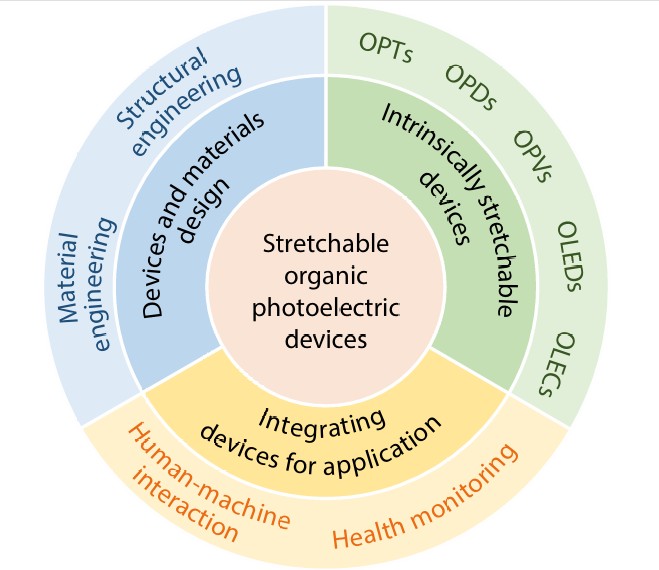
Conventional approaches to achieving stretchability have relied on structural engineering strategies such as buckling configurations or island-bridge architectures. While these methods can confer stretchability at the device level, they come with fundamental limitations: complex fabrication processes, restricted uniaxial deformation capabilities, and inevitable trade-offs between stretchability and device density. More fundamentally, the inherent conflict between optoelectronic performance and mechanical stretchability at the material level has remained a formidable obstacle. Organic semiconductors achieve high charge carrier mobility through highly ordered molecular packing and rigid, planar backbones, whereas stretchability requires chain segment mobility and reduced crystallinity. The central challenge lies in breaking this inverse relationship without sacrificing the optoelectronic properties that make organic materials so attractive.
A comprehensive review published in Chinese Journal of Polymer Science on June 24, 2026, systematically addresses these challenges. The work, conducted by researchers at the Institute of Chemistry, Chinese Academy of Sciences, and the University of Chinese Academy of Sciences, provides a roadmap for developing intrinsically stretchable organic photoelectric conversion systems through molecular and composite engineering strategies.
The review, led by Professor Yun-Long Guo and colleagues Yue-Yue Zhang, Yi-Li Wang, and Yun-Qi Liu, covers the full spectrum of stretchable organic optoelectronic devices, including organic photodiodes (OPDs), organic phototransistors (OPTs), organic photovoltaics (OPVs), organic light-emitting diodes (OLEDs), and organic light-emitting electrochemical cells (OLECs). The authors detail how molecular-level design—including backbone engineering, side-chain modification, and the incorporation of dynamic non-covalent bonds—can simultaneously enhance mechanical deformability and preserve charge transport efficiency. For example, introducing flexible conjugation break spacers or hydrogen-bonding units into polymer backbones has yielded semiconducting polymers with fracture strains exceeding 100% while maintaining hole mobilities above 1 cm²·V⁻¹·s⁻¹. The review also highlights composite strategies that blend conjugated polymers with elastomers, achieving nanoconfinement effects that dramatically enhance stretchability without compromising electrical performance—one polymer blend demonstrated a mobility of 1.32 cm²·V⁻¹·s⁻¹ even under 100% tensile strain.
“The past decade has witnessed a fundamental paradigm shift in how we approach stretchable electronics,” the authors said. “Rather than relying on mechanical structures to compensate for brittle materials, we can now design organic semiconductors that are inherently stretchable at the molecular level. This opens up entirely new possibilities for seamless integration with biological tissues and enables devices that can be worn or even implanted without the mechanical mismatch that causes discomfort and device failure.”
The implications extend far beyond fundamental materials science. Intrinsically stretchable organic optoelectronic systems are poised to revolutionize human-machine interfaces, neuromorphic computing, and wearable health monitoring. The review describes integrated systems that combine stretchable phototransistor arrays with tactile sensors to create artificial skin capable of adaptive perception and learning—mimicking biological sensory functions such as visual adaptation and synaptic plasticity. In healthcare applications, self-powered wearable patches integrating stretchable organic photovoltaics with organic photodiodes and light-emitting diodes have demonstrated real-time photoplethysmography (PPG) monitoring with high signal-to-noise ratios, operating without batteries by harvesting energy from ambient light. As manufacturing techniques scale up and materials continue to improve, these technologies promise to deliver closed-loop intelligent systems that can sense, process, and respond—bringing truly conformable, biocompatible, and autonomous optoelectronics from laboratory prototypes to everyday reality.
References
DOI
10.1007/s10118-026-3652-3
Original Source URL
https://doi.org/10.1007/s10118-026-3652-3
Funding Information
This work was financially supported by the National Natural Science Foundation of China (Nos. 22525506, U22A6002, and T2441002), Strategic Priority Research Program of CAS (No. XDB0520101), CAS Project for Young Scientists in Basic Research (No. YSBR-053), and Beijing Natural Science Foundation (No. Z250016).
Lucy Wang
BioDesign Research
email us here
Legal Disclaimer:
EIN Presswire provides this news content “as is” without warranty of any kind. We do not accept any responsibility or liability
for the accuracy, content, images, videos, licenses, completeness, legality, or reliability of the information contained in this
article. If you have any complaints or copyright issues related to this article, kindly contact the author above.

Media gallery